
Everyone Talks About the Semantic Layer — But What Does It Actually Do?
Lately the term “semantic layer” is showing up everywhere in modern data and AI conversations. It sounds technical, important, and vaguely necessary. But for most operators, it’s still unclear what it actually does—or why it matters.
The simplest way to understand it is this: a semantic layer is context. It is what makes your data reflect how your business actually works. And that is much harder than it sounds.
Why CRMs and Agents Make This Worse
CRMs like HubSpot are designed to be flexible. That flexibility is one of their biggest strengths—and one of the biggest sources of analytical inconsistency. Teams create custom properties, custom objects, and custom lifecycle stages to match how they operate. Over time, those changes reflect real business nuance: how deals are qualified, how revenue is attributed, how handoffs occur between teams. But that also means every CRM becomes deeply customized—and deeply inconsistent from a data perspective.
Now layer AI agents on top.
Agents don’t just read data—they increasingly write it. They update fields, move deals, trigger workflows, and generate new records automatically. In doing so, they accelerate how quickly data changes and how much data is created. But they operate based on rules, prompts, and partial context—not a fully aligned understanding of the business. So instead of reducing inconsistency, they can amplify it. You end up with more data, changing faster, shaped by multiple systems and actors—without a shared definition of what any of it actually means.
What a Semantic Model Actually Is
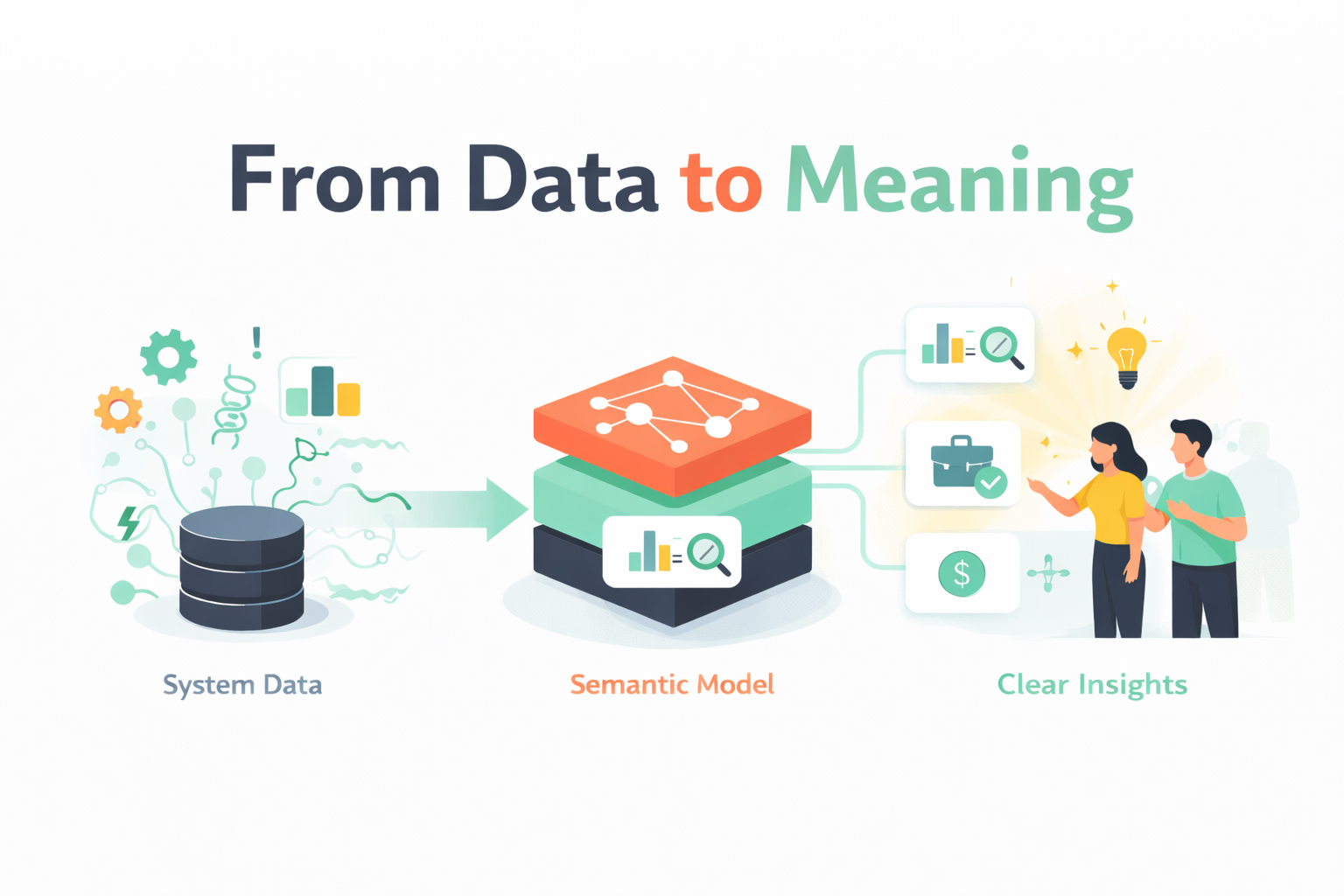
A semantic model is the layer that brings structure to that chaos. It translates system-level data into business-level meaning—not generically, but in a way that reflects how a specific company operates. At a surface level, this looks like mapping fields across systems into shared concepts like revenue, pipeline, and cash. But that’s only part of it.
From Data to Meaning
A true semantic model captures how those concepts are defined in practice. It encodes the logic behind metrics, the relationships between entities, and the way different systems connect across the customer lifecycle. It answers questions like:What actually counts as revenue in this business?When does a deal become real pipeline?How do bookings relate to cash collection?Those answers are rarely universal. They are shaped by decisions, edge cases, and operational realities that exist inside the company. The semantic model is where that logic lives.
Why RevOps Breaks Without It
Without this layer, every question becomes an interpretation problem. RevOps teams are constantly translating between systems, reconciling conflicting definitions, and rebuilding analyses depending on who is asking. The same metric can produce different answers depending on how it is calculated, which system is referenced, or which assumptions are applied. Over time, this creates friction across the organization. Numbers don’t align. Reports don’t reconcile. Confidence erodes. And the burden falls on RevOps to explain, adjust, and defend the logic behind every answer. The issue isn’t that the data is unavailable. It’s that the meaning of the data is not consistently defined.
What’s Actually Happening Under the Hood
Under the hood, a semantic model standardizes how entities, metrics, and relationships are defined across systems—but it does so in a way that reflects real operational behavior. It aligns core objects like customers, deals, invoices, and subscriptions. It defines how metrics like CAC, LTV, churn, and revenue are calculated. It connects the relationships between pipeline, revenue, and cash so that questions can span the full lifecycle. But more importantly, it embeds the business logic that sits between those systems. This creates an abstraction layer where questions are interpreted through the lens of the business—not just the structure of the data.
Why This Matters Now
As AI becomes the primary interface for interacting with data, the importance of this layer increases. AI makes it easier to ask questions. But it also raises the stakes of getting answers that reflect how the business actually operates. Without a clearly defined semantic layer, every answer depends on implicit assumptions. With one in place, those assumptions are made explicit, consistent, and reusable. That is what turns data access into decision support.
Where DDAI Fits
At DDAI, this is the layer we’ve focused on from the beginning. The goal is to deliver an out-of-the-box, enterprise-grade data stack that includes a built-in semantic layer—so SaaS companies don’t have to define and reconcile their business logic from scratch. That vision is clear, but it is still in progress. Today, building that semantic layer involves working directly with our customers as business analysts—understanding how their systems are actually used and uncovering the “tribal processes” embedded across CRM, billing, and finance workflows. Those nuances are what shape how metrics are truly defined in practice.
The objective isn’t just to connect systems. It’s to ensure that when a question is asked, the answer reflects how the business actually operates—consistently, and without interpretation.
Over time, that work will feed into a more standardized, scalable model—one that moves toward delivering a true out-of-the-box semantic layer. That's our vision. And we’re working hard to achieve it.
👉 Want to see how it works?Book a demo.
