
RevOps Use Case Series (Part 1): Executive & Investor KPI Reporting Without the Fire Drill
RevOps teams are supposed to be strategic partners to leadership. In reality, they’re often stuck responding to the same high-pressure request over and over again:
“Can you pull together the latest numbers for the exec team?”
This post kicks off a short series breaking down the most painful RevOps use cases we see across SaaS and tech companies — and how DDAI helps remove the friction.
We’ll start with a big one: executive and investor KPI reporting.
The Problem: Executive Reporting Is a Constant Fire Drill
Monthly and quarterly reporting cycles are stressful for a reason. Executives and investors want a clean, trusted view of the business — revenue, pipeline, growth, spend, and cash — and they want it fast.
But the data required to answer those questions lives across disconnected systems. HubSpot holds pipeline and bookings. Stripe tracks subscriptions, invoices, and payments. QuickBooks reflects actual revenue, expenses, and cash. Each system is accurate on its own, but none tells the full story.
To deliver reports, RevOps teams export data, reconcile mismatched definitions, and stitch everything together in spreadsheets or dashboards. The process is manual, fragile, and time-consuming. Every metric sparks follow-up questions. Every follow-up creates more work.
By the time the report is shared, it’s already out of date.
What Executives Are Really Asking For
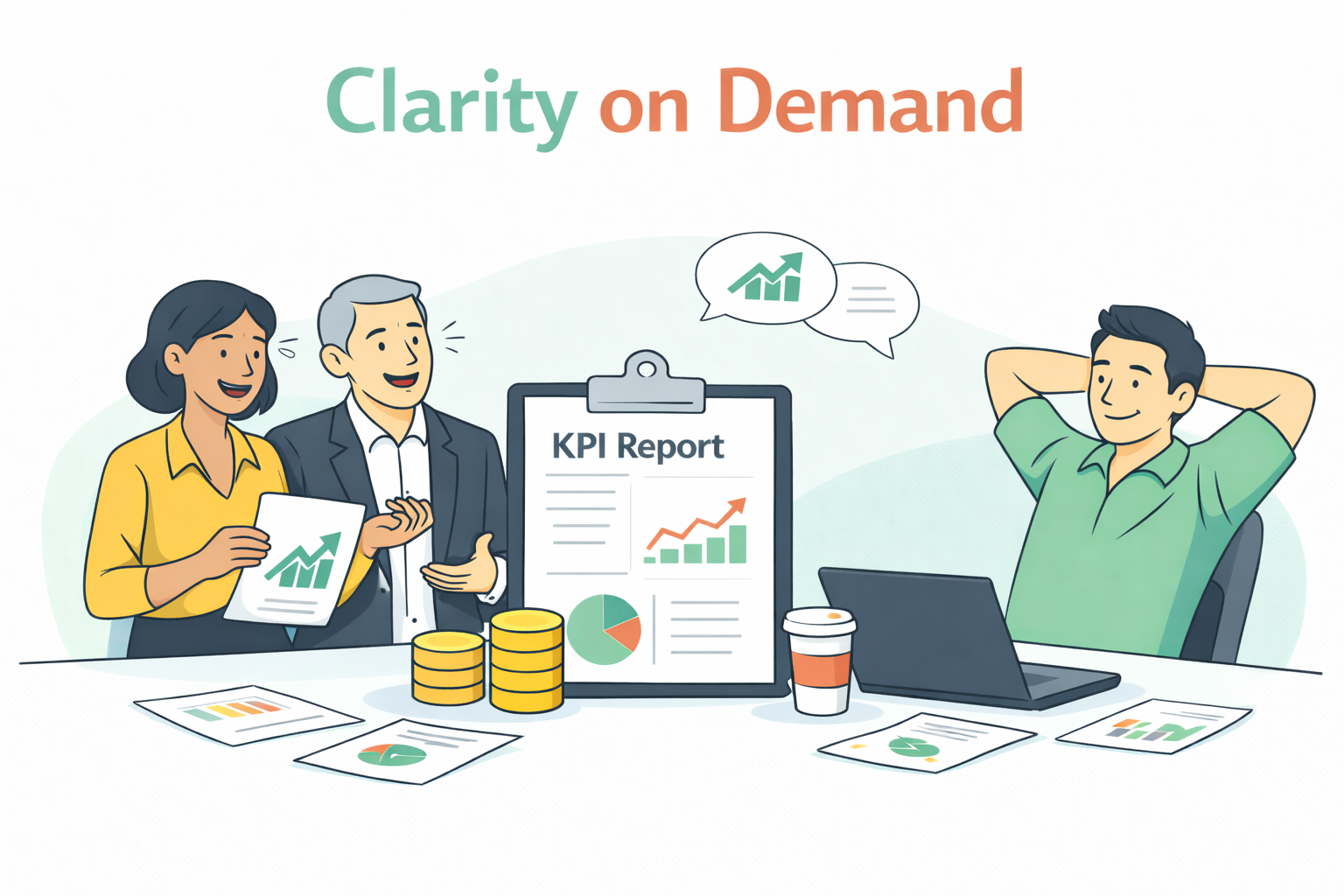
Leadership isn’t asking for dashboards — they’re asking for answers. Questions like:
“Show ARR, net new ARR and NRR for last quarter.”
“Create a simple quarterly summary with pipeline, bookings, revenue, and current cash.”
“Compare budget vs. actual spend last quarter — what changed?”
With traditional tools, each question requires a new report or spreadsheet. That’s what turns RevOps into a bottleneck instead of a force multiplier.
Why This Keeps Breaking Down
Dashboards are static. Spreadsheets are brittle. And neither adapts well when definitions change or leadership asks a slightly different question.
As a result, RevOps spends more time explaining numbers than improving outcomes — and executive confidence erodes when answers feel slow or inconsistent.
How DDAI Changes Executive Reporting
DDAI connects HubSpot, QuickBooks, and Stripe into a unified Common Data Model and applies a semantic layer tuned specifically for RevOps questions. Revenue, pipeline, spend, and cash are always aligned — without manual reconciliation or report rebuilding.
Instead of maintaining dashboards, RevOps asks questions in plain English and gets answers grounded in live, cross-system data. It feels like chatting with an always-on data analyst who already understands your business and can respond instantly when leadership asks, “Can we look at this another way?”
From Reporting Factory to Strategic Partner
With DDAI, executive reporting stops being a monthly scramble. RevOps delivers clarity on demand, leadership stays aligned around trusted numbers, and conversations move faster — from “Are these numbers right?” to “What should we do next?”
👉 [Book a demo] | See how it works when you start your trial!
