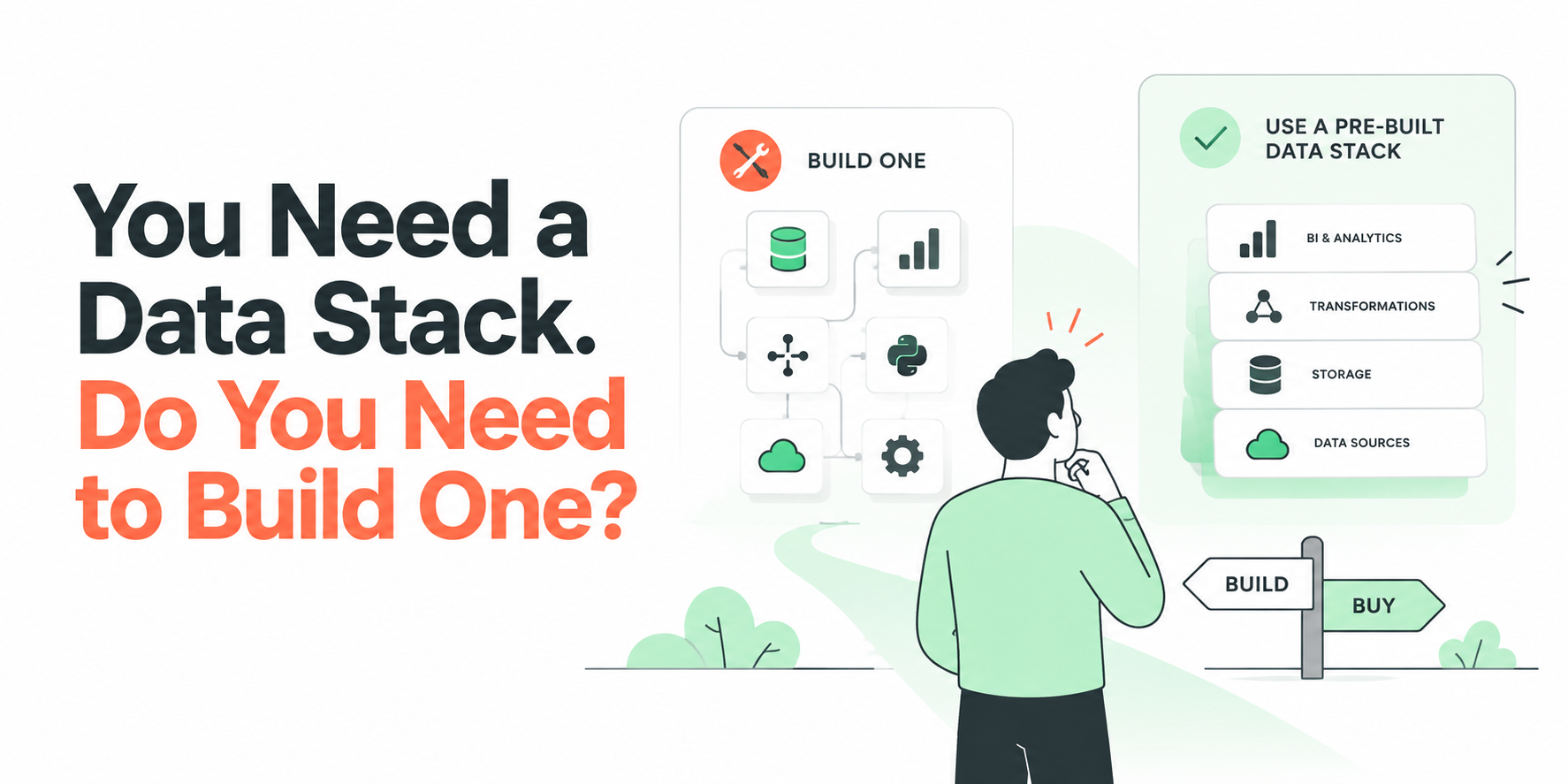
Growing SaaS companies need reliable data across sales, marketing, finance, and customer operations. But getting consistent numbers from systems like HubSpot, Stripe, and QuickBooks has traditionally required building a data stack and hiring technical expertise to maintain it.
Today, companies have three practical options: build a data stack with an internal team, hire external specialists to build one, or subscribe to a managed data platform. The first two require building and owning your infrastructure. The third provides the capabilities without the engineering overhead.
Three Ways to Get a Modern Data Stack
A modern data stack typically includes ingestion pipelines, a data warehouse, transformation workflows, standardized business definitions, and connections to reporting and analytics applications.
For SaaS companies, this infrastructure must reconcile customers, subscriptions, invoices, payments, and financial records into a consistent view of business performance, ensuring one trusted number for key metrics such as ARR, CAC, and NRR.
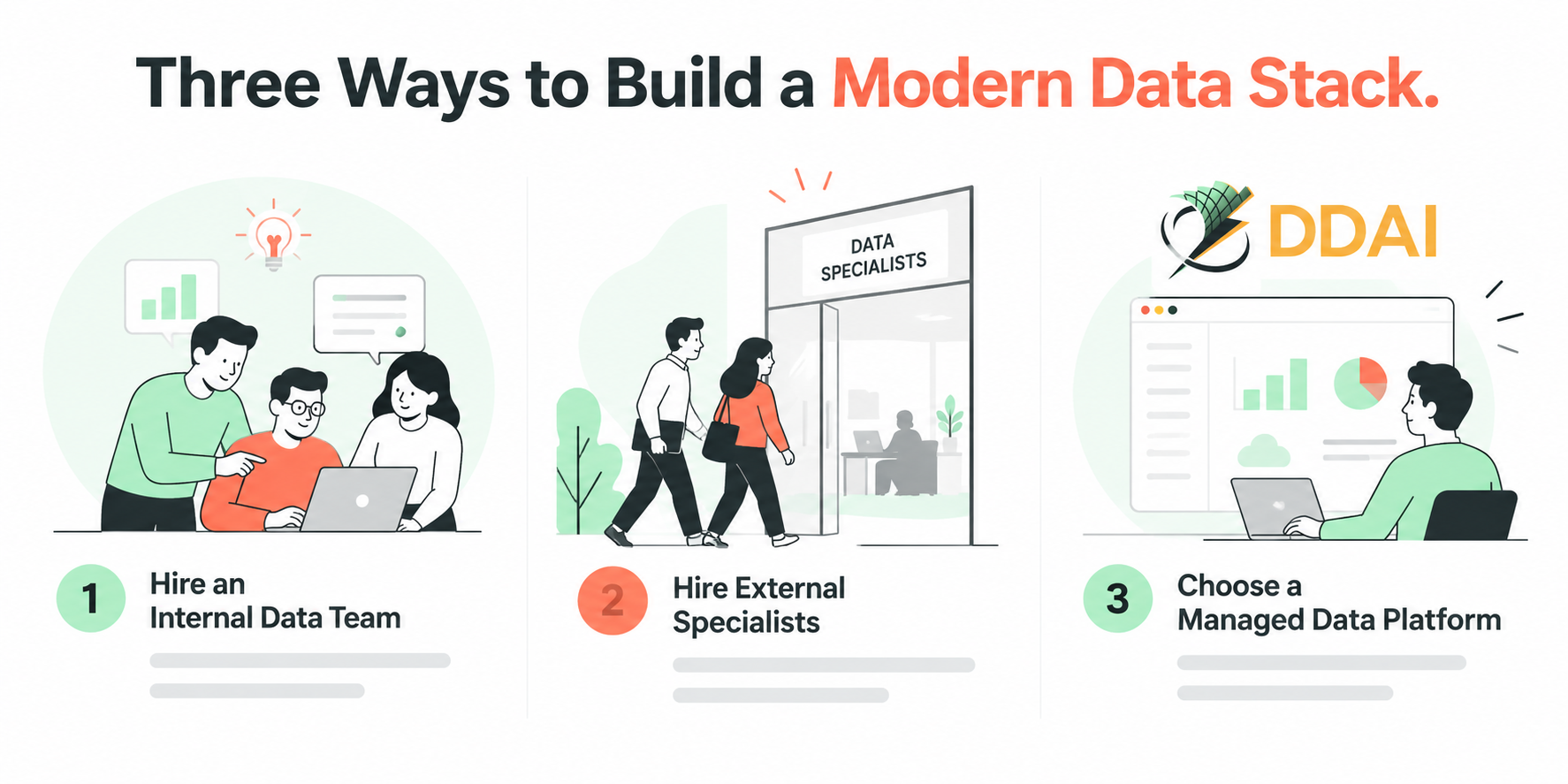
Companies can obtain these capabilities through three approaches. They can hire an internal team to build and operate their own data stack, engage external specialists to design and implement one, or subscribe to a managed platform that provides and maintains the underlying infrastructure. The first two offer greater architectural control but leave the company responsible for ongoing operations. The managed approach reduces that technical burden in exchange for working within the platform’s supported capabilities.
| Approach | What you’re buying | Typical implementation timeline | Typical cost |
|---|---|---|---|
| Hire an internal data team | Full-time engineers and analysts to build, operate, and improve your infrastructure | 3–6+ months once staffed; recruiting may add several months | $200K–$400K+ annually for a small team; software and infrastructure additional |
| Hire external specialists | Consultants, fractional teams, or contractors to design and implement your stack | 3–6+ months; vendor selection and contracting may add time | $50K–$150K+ for implementation; ongoing infrastructure, software, and maintenance additional |
| Use a managed data platform | A subscription to a managed operational data foundation with supported integrations, harmonization, and ongoing maintenance | Often weeks for standard, supported implementations; complex requirements may take longer | Subscription-based; DDAI plans start at $149/month, with Mastery at $1,999/month |
Costs and timelines are directional planning estimates, not guaranteed quotes. Actual requirements depend on scope, staffing, technical complexity, and provider. For consulting cost context, see BD Emerson’s data engineering consulting benchmarks and White Tree Solutions’ pricing overview. Managed-platform pricing reflects DDAI’s listed plans.
Building In-House
An internal team provides maximum control over architecture, integrations, and data models. This makes sense for companies with proprietary systems, complex analytical requirements, or a strategic need to develop internal data capabilities.
The trade-off is a significant fixed investment. Beyond compensation, the company assumes responsibility for infrastructure, monitoring, and continuous development.
Outsourcing the Build
Consultancies, fractional data teams, and contractors provide technical expertise without permanent headcount. They’re useful for specialized requirements or defined implementation projects.
However, outsourcing implementation doesn’t eliminate ongoing responsibility. Pipelines need monitoring, integrations require maintenance, and business models evolve. That means retaining external support or eventually developing internal capabilities.
Either way, your company owns the resulting infrastructure and its long-term operating costs.
Using a Managed Data Platform
A managed data platform offers a different economic and operational model.
Instead of assembling technologies and hiring specialists to integrate them, you subscribe to a platform that handles supported integrations, data harmonization, storage, and ongoing synchronization.
For growing SaaS companies, the advantages include lower upfront investment, more predictable costs, faster implementation, and reduced dependence on specialized employees.
This approach works particularly well when operational data resides in established SaaS applications and the primary challenges involve inconsistent metrics, fragmented reporting, and spreadsheet reconciliation.
The trade-off is flexibility. Managed platforms may not support every proprietary system or specialized transformation. Companies requiring extensive customization or complete architectural control may be better served by building their own stack.
The decision comes down to whether your business needs custom infrastructure or the trusted data that infrastructure is supposed to produce.
Where DDAI Fits: A Managed Alternative to Building Your Own Stack
Data Discourse AI (DDAI) is a managed, AI-ready data platform built for growing SaaS and technology companies.
DDAI connects HubSpot, QuickBooks Online, Stripe, and other supported business systems. It automatically extracts and harmonizes their data, applies a Common Data Model and semantic layer, and maintains continuous synchronization.
The result is a trusted operational data foundation with consistent business definitions across revenue, sales, marketing, finance, and customer operations.
Teams can access that data through their preferred tools:
- BI and analytics: Excel, Power BI, Tableau, and other ODBC-compatible tools.
- AI agents: ChatGPT, Claude, and custom AI applications through MCP.
- DDAI Chat: Natural-language access to business metrics.
Each interface uses the same underlying data foundation, helping reduce conflicting reports and manual reconciliation.
The Cost Advantage
Building a custom data stack creates two financial commitments: the initial investment in engineering and the recurring expense of operating the infrastructure. DDAI offers a different cost structure by providing the underlying data foundation through a managed subscription.
At approximately $24K annually for DDAI Mastery, the subscription costs about 88% less than a $200K annual internal team budget.
These aren’t identical services. Internal and external engineering teams offer broader custom development capabilities. But for companies using supported SaaS systems, DDAI can provide the operational data foundation without the cost and complexity of building it.
Avoiding custom pipelines, infrastructure maintenance, and recurring engineering work can reduce the total cost of ownership over time.
Find Out Whether You Need to Build a Data Stack
Before committing to hiring or an infrastructure project, assess what your business actually requires.
DDAI is currently offering a free Data Readiness Audit to qualified businesses, normally valued at approximately $1,000, to evaluate their current data environment, identify reporting gaps, and determine whether a managed platform can meet their needs. The audit starts with DDAI Explore, offering 90 days of free access using a one-time data snapshot.
You need trusted data to make better decisions. You don’t necessarily need to build the infrastructure to get it.