
Three possible futures for artificial intelligence. One company that might do just fine in all of them.
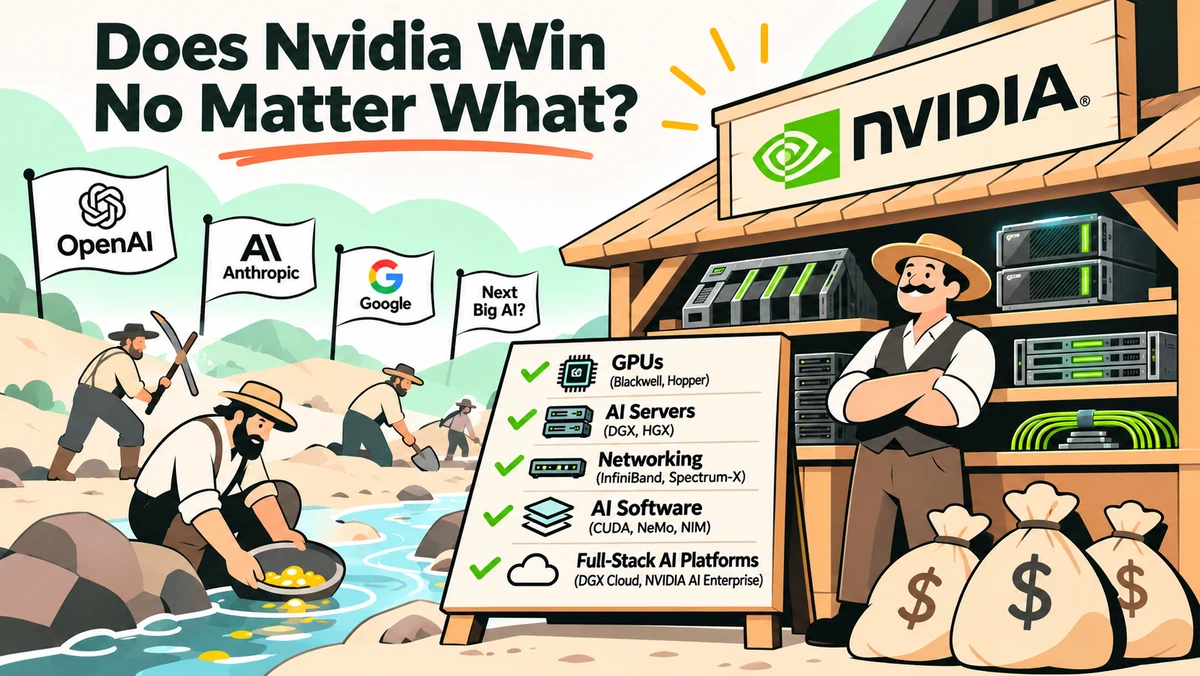
There’s an old saying about the California Gold Rush: the people who made the real money weren’t necessarily the ones digging for gold. They were the folks selling the picks, shovels, and blue jeans. I keep coming back to that analogy when I look at the staggering amounts of money being poured into AI infrastructure. Everybody is trying to figure out whether OpenAI, Anthropic, Google, or somebody we haven’t heard of yet will win the AI race. Meanwhile, Nvidia is selling the picks and shovels to just about everybody. And business, at least for now, is pretty darn good.
With Anthropic preparing for its IPO, investors questioning the sustainability of AI spending, and Nvidia navigating a leadership transition following Jensen Huang’s departure, it’s worth asking a simple question: Does Nvidia win no matter what happens next?
Jensen Huang’s Five-Layer Cake
Jensen Huang has a useful way of describing the AI economy. He calls it the five-layer cake. It’s a simple framework for understanding how the ecosystem fits together, and where all the money is going.
Starting at the bottom:
Layer 1 — Energy: The electricity required to power all this computing. The AI revolution requires hundreds of gigawatts of additional electricity capacity.
Layer 2 — Chips: GPUs, CPUs, memory, and networking silicon. Nvidia’s sweet spot.
Layer 3 — Infrastructure: Data centers, cloud platforms, networking, and cooling systems.
Layer 4 — Models: The intelligence being developed by OpenAI, Anthropic, Google, Meta, Nvidia, DeepSeek, and others.
Layer 5 — Applications: Where AI becomes useful to the rest of us. Software, autonomous agents, robotics, scientific research, and thousands of potential new businesses.
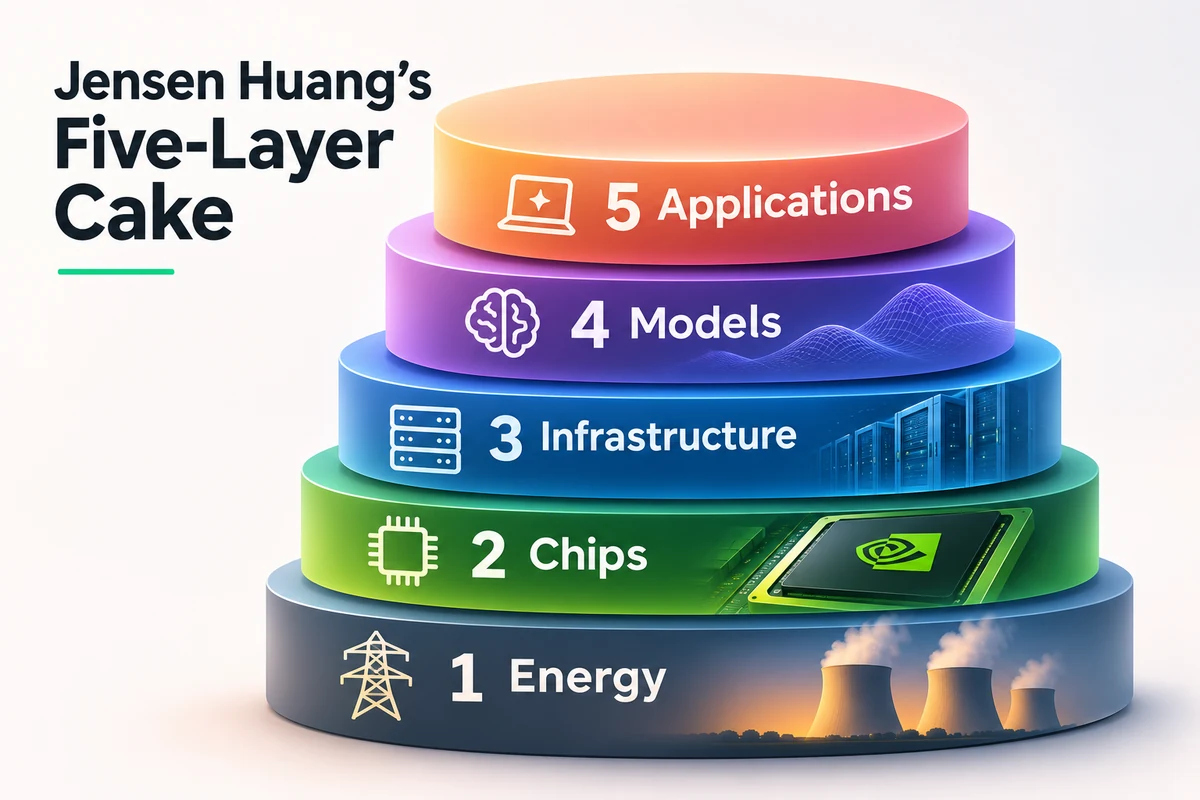
Each layer depends on the one below it. You can’t have applications without models, models without infrastructure, infrastructure without chips, or any of it without electricity.
Everyone is fascinated by the models and applications because that’s where we see the magic. But somebody has to build and power the machinery underneath it all. And Nvidia happens to be sitting in a pretty enviable position.
I see three plausible futures for AI. Nvidia looks well positioned in all three.
Scenario One: The Frontier Labs Win
Let’s assume OpenAI, Anthropic, Google, and the other frontier labs continue pushing toward increasingly capable models, eventually reaching something resembling artificial general intelligence. But building amazing models isn’t enough. They need to keep the world captivated by what those models can do. Enterprises need real business value, consumers need to keep coming back, and adoption and usage need to keep growing.
To understand the economics, it’s worth distinguishing between two major drivers of AI computing demand:
Training — creating the intelligence. Frontier labs spend billions training increasingly sophisticated models on enormous GPU clusters, making each generation smarter and more capable.
Inference — using the intelligence. Every question, generated image, line of code, or autonomous agent task requires computing power. The more people and businesses use AI, the more inference capacity is needed.
Training is driven by the race to build better models. Inference is driven by adoption and usage. If both keep growing, Nvidia potentially benefits twice.
Consider the numbers. Anthropic’s IPO filings describe approximately $895 billion in computing and infrastructure commitments, with roughly $70 billion scheduled over the following year. Nvidia recently reported $107.6 billion in quarterly data-center revenue, more than double the year-earlier figure. Annualize that quarter and you’re looking at a run rate north of $430 billion.
Now imagine, if you will, Nvidia becoming the first company to reach a $1 trillion annual revenue run rate. That would require more than doubling its current data-center run rate, so it’s hardly a foregone conclusion. But given the trajectory of AI infrastructure spending, it doesn’t seem quite as far-fetched as it once would have. A trillion dollars a year. Crazy!
And inference could ultimately become the bigger opportunity. Imagine billions of people using AI throughout their day while businesses deploy armies of agents working around the clock. Training a model is a major but finite undertaking. Inference happens every time somebody puts that intelligence to work.
If the frontier labs keep advancing and the world keeps adopting what they build, Nvidia should be in a terrific position. Pretty straightforward.
Scenario Two: Open Source Eats the Frontier Labs’ Lunch
Now let’s consider a very different outcome.
Open-source and open-weight models are improving rapidly. Meta, DeepSeek, Mistral, Nvidia, and others are developing models that, in certain applications, compete with proprietary alternatives at a fraction of the cost. In some areas, the gap between open and frontier models appears to be narrowing to months rather than years.
Here’s the part I find fascinating. Fast-forward to Q4 2028. Imagine open models are only one quarter behind the frontier labs. In other words, the best open models in Q4 2028 have capabilities comparable to what OpenAI, Anthropic, or Google achieved in Q3 2028.
Think about that. We’re not talking about catching up to today’s models. We’re talking about nearly frontier-level intelligence in a world where the frontier itself has advanced another two years. Those could be astonishingly powerful models. Maybe even approaching AGI. Holy smokes.
Of course, a consistent one-quarter lag is a hypothesis, not an established rule. But even if the gap is wider, the implications are enormous.
If I’m running a business and can get comparable intelligence from an open model at dramatically lower cost, why pay a premium to a frontier provider? Particularly if I can customize it, control my data, and deploy it wherever I want?
That could put serious pressure on the frontier labs’ business models. But here’s where things get interesting for Nvidia. Those open models still have to run somewhere.
Most businesses won’t build their own data centers. They’ll run these models on AWS, Azure, Google Cloud, or other infrastructure providers. Larger enterprises might deploy them on-premises for security, latency, or data sovereignty. Either way, somebody needs the hardware.
Imagine 100,000 enterprises spending $1 million annually on open-model computing infrastructure and services. That’s a $100 billion market. At $5 million each, it’s $500 billion. These aren’t forecasts, just back-of-the-envelope math illustrating the possibilities. Only a portion would flow into GPU purchases.
Nvidia doesn’t have the field to itself. AMD, Google’s TPUs, and custom hyperscaler chips are legitimate competitors. But Nvidia’s hardware, networking, and software ecosystem give it a substantial head start.
Even if open source disrupts the frontier labs’ economics, it could dramatically expand the market for computing infrastructure. Not a bad consolation prize.
Scenario Three: Everybody Wins, and AI Goes Everywhere
My suspicion is that reality will look like a combination of the first two scenarios. Frontier models keep advancing, open models become increasingly capable and affordable, and an enormous ecosystem of applications develops around both.
The frontier labs aren’t content to remain model providers. They’re moving up Huang’s five-layer cake into applications, where the customer relationships and potentially much larger revenue opportunities exist.
And then there are AI agents. This is where the numbers start getting downright ridiculous.
Think about AI systems that move beyond answering questions and start doing actual work. Writing software, managing customer relationships, analyzing financial statements, preparing legal documents, handling insurance claims, running marketing campaigns, and coordinating business processes. In a very real sense, the frontier labs aren’t just targeting software anymore. They’re potentially targeting a meaningful share of the work performed by the global white-collar workforce.
Depending on how you define it, that’s something on the order of a $20 trillion annual labor market. Not a forecast of AI revenue, but an enormous pool of economic activity that agents could augment or automate. Capturing even a small fraction would create a massive industry.
And the frontier labs could capture much more than token revenue. Consider an AI application serving one million customers at $100 per month. That’s $1.2 billion in annual revenue. If Anthropic or OpenAI owns the application, it could capture the full $1.2 billion, not merely the inference fees, while covering the costs of operating the business.
If 20% of revenue goes toward inference, that’s $240 million annually in computing costs for one application. Now imagine thousands of agents working continuously across millions of businesses, researching, reasoning, executing tasks, and coordinating with other agents.
All of that requires compute. Potentially a staggering amount of it.
And once again, Nvidia is standing there with the picks and shovels.
The Part That Really Gets Me Excited
We spend so much time talking about chatbots, coding assistants, and which company has the smartest model that I think we miss the bigger picture. AI has the potential to improve the human condition in ways that are difficult to overstate.

Companies like Isomorphic Labs and Insilico Medicine are applying AI to drug discovery. Imagine dramatically reducing the time required to develop treatments for devastating diseases. Robotics companies like Figure AI and Physical Intelligence are working on machines capable of increasingly complex physical tasks. AI could help farmers produce more food with fewer resources, improve electrical grids, accelerate materials science, and make high-quality education and healthcare accessible to billions more people.
Then there are thousands of smaller companies building specialized AI applications for marketing, finance, manufacturing, logistics, scientific research, and industries most of us rarely think about. Some will succeed. Plenty will fail. That’s how technology revolutions work.
But the cumulative effect could be profound. Nearly every one of these advances will require computing power, whether in a massive cloud data center, a corporate server room, or eventually inside a robot.
The opportunity isn’t just making existing software smarter. It’s creating entirely new markets and capabilities that weren’t economically practical before. And yes, a lot of those markets will need chips.
So, Does Nvidia Win No Matter What?
I’m not suggesting Nvidia is invincible. Competition is real, model efficiency is improving, and there’s a legitimate question about whether all this infrastructure spending will generate adequate returns. Investors can also be right about a company’s long-term prospects and still pay far too much for its stock.
But I keep coming back to the same conclusion. Whether frontier labs dominate, open source changes AI economics, or thousands of specialized applications flourish, the world is likely to need an awful lot more computing capacity.
Nvidia doesn’t have to win every application or build the smartest model. It doesn’t even have to manufacture every chip. It just needs to remain a major supplier to an industry that could keep growing for a very long time.
Maybe the most important question isn’t who wins the AI race. Maybe it’s who keeps selling the picks and shovels while everybody else is digging for gold.
Bringing It Back to Earth
Of course, all this talk about trillion-dollar companies, AGI, and autonomous agents is pretty heady stuff. Most businesses are still figuring out how to put AI to work. That’s something I see firsthand building Data Discourse AI (DDAI).
One thing I’ve learned is that even the smartest AI models aren’t particularly useful if they can’t access reliable business data. If your revenue numbers don’t match, customer information is scattered across systems, and nobody agrees on how churn is calculated, what good is an intelligent agent?
That’s why we built DDAI: to give growing businesses a trusted, AI-ready data foundation without the cost and complexity of building their own enterprise data stack.
I suspect intelligence will become increasingly powerful and inexpensive. But the businesses that benefit most will be the ones that have their data in order and know what to do with it.
Learn more about Data Discourse AI.
Disclaimer: These are my personal observations about the AI industry, not investment advice or a recommendation to buy or sell Nvidia or any other security. The scenarios discussed are speculative, and actual outcomes could be very different.