
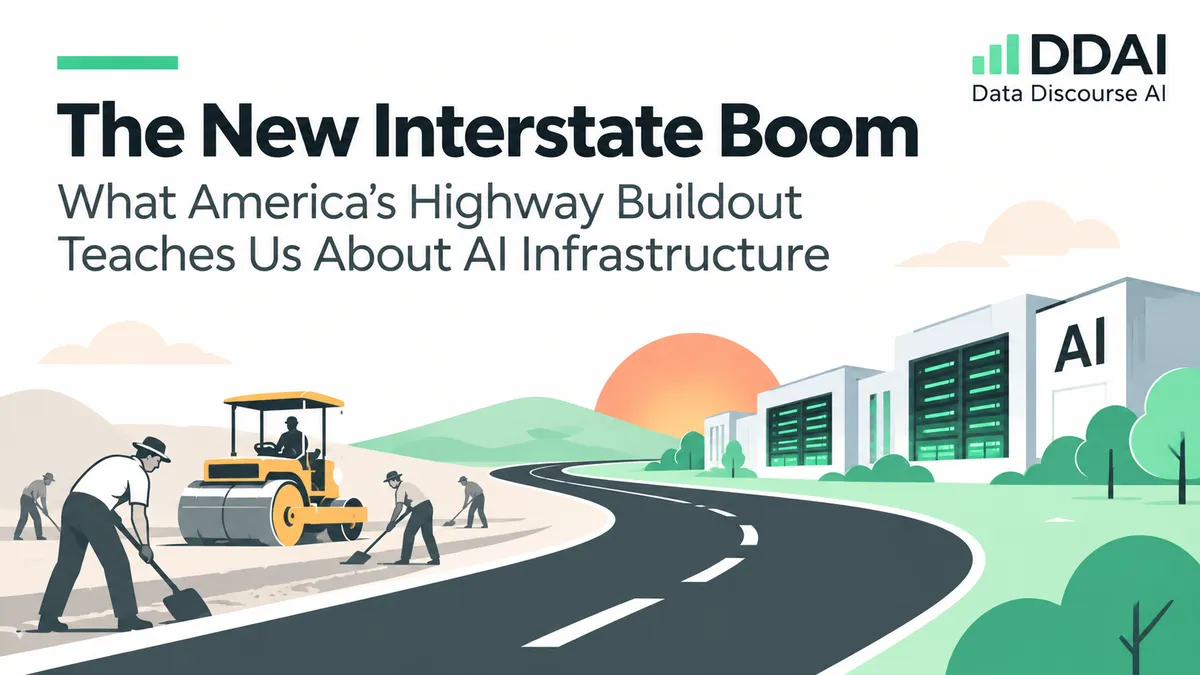
In 1956, America embarked on one of the largest infrastructure projects in history: a 41,000-mile interstate highway system designed to accommodate exploding automobile traffic, expand commerce, and strengthen national defense. Seventy years later, we’re doing something remarkably similar. Only this time, we’re building infrastructure to move data instead of cars.
The AI boom may look like a digital revolution, but underneath it is an enormous physical construction project. Tech giants are pouring hundreds of billions into data centers, electrical grids, and fiber networks to support computing demand that existing infrastructure can’t accommodate. Like the interstate buildout, the investment is being justified through economic opportunity, national security, and the promise of long-term benefits.
But here’s where the history gets interesting. We tend to assume that once essential infrastructure gets built, everyone eventually accepts the trade-offs. The interstate highway system tells a different story.
The New Right-of-Way: Progress Meets Local Resistance
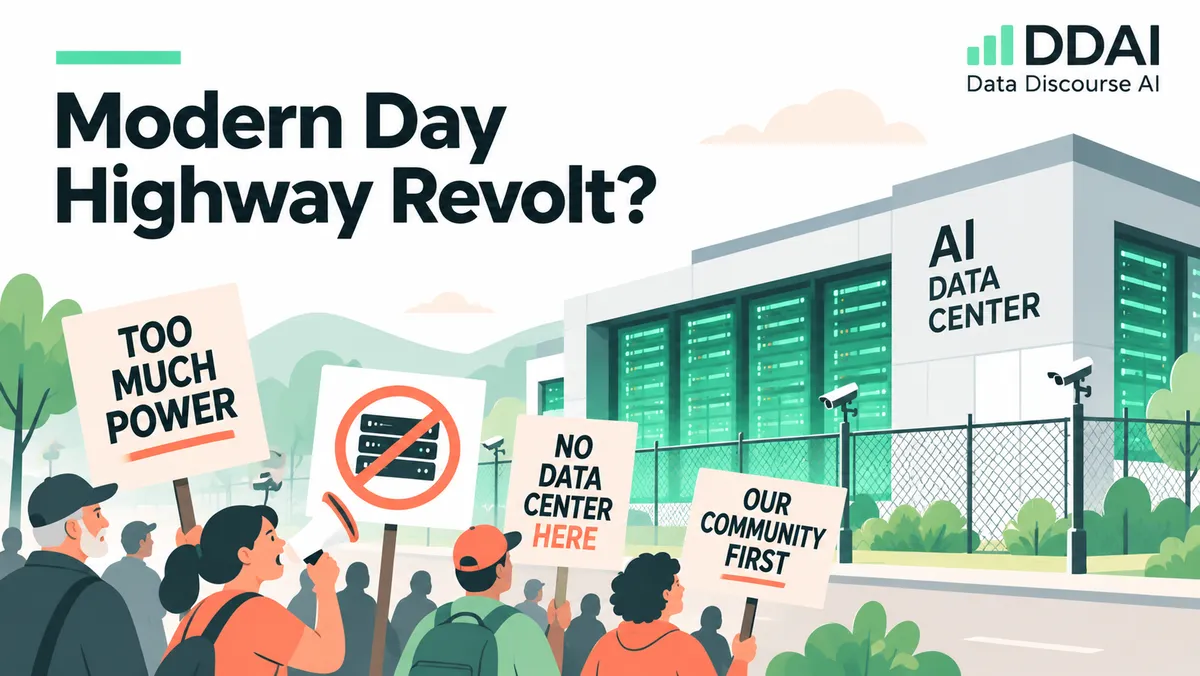
Building America’s interstate system required enormous land acquisitions, often through eminent domain. Highways divided farms, displaced urban neighborhoods, and redirected commerce away from established business districts. The backlash eventually produced the highway revolts of the 1960s and 1970s, when communities successfully challenged major freeway projects in cities like San Francisco and Boston.
Today, we’re seeing similar tensions around data center development. Northern Virginia, Ohio, and other growing data center markets are confronting the physical realities of infrastructure most people still think of as digital. Data centers require enormous electrical capacity, which means new transmission lines, substations, and utility corridors. Landowners are pushing back against power lines crossing private property, while nearby residents raise concerns about industrial noise, changing landscapes, and electricity costs.
There’s also a familiar economic disconnect. A multibillion-dollar data center can generate significant construction activity and tax revenue, but relatively few permanent jobs. Communities may absorb much of the infrastructure footprint without seeing the economic benefits they expected.
Even the old highway bypass problem has a modern equivalent. Interstate highways redirected travelers away from small-town main streets, damaging businesses dependent on passing traffic. Today, high-capacity fiber networks can pass through rural communities while connecting major data centers to metropolitan markets, without necessarily improving local broadband access. Infrastructure passing through a community doesn’t necessarily mean that community benefits from it.
National Security: The Argument That Changes Everything
Eisenhower understood that the interstate system was about more than transportation. During the Cold War, a connected highway network promised faster military mobilization and more efficient evacuation routes. Its designation as the National System of Interstate and Defense Highways helped reinforce the national security case for an enormous federal investment.
Today, we’re hearing a remarkably similar argument. AI computing capacity is increasingly framed as essential to national security, economic competitiveness, and technological independence. That framing is helping drive efforts to accelerate permitting, expand electrical generation, and remove barriers to data center construction.
The security concerns are legitimate, but the historical parallel raises an uncomfortable question: When infrastructure becomes a national priority, how much influence should local communities have over the costs they’re being asked to absorb?
The Myth of the Happily Ever After
It’s tempting to look at the interstate system as proof that massive infrastructure projects eventually win everyone over. After all, highways transformed American commerce and remain essential to the economy. But many of the problems created during their construction never went away.
Consider induced demand. Expanding highways often encourages more driving, eventually filling the additional capacity and recreating congestion. Meanwhile, maintaining aging roads and bridges has become an enormous financial burden. The American Society of Civil Engineers estimates that U.S. bridges alone require roughly $191 billion in rehabilitation investment.
Then there’s the social legacy. Highways divided established neighborhoods, displaced residents, and permanently altered urban economies. Cities like Syracuse are now spending billions to remove or redesign infrastructure built decades ago.
The lesson isn’t that highways were a mistake. It’s that economically successful infrastructure can create permanent problems alongside its benefits. We should be careful about assuming the AI buildout will be any different.
Where the Analogy Breaks: The Risk of a Digital Rust Belt
There’s one important difference between highways and data centers: the pace of technological change. A highway built in 1960 still serves essentially the same purpose today. People and goods need physical transportation, regardless of how vehicles evolve.
AI infrastructure faces a different risk. What happens if computing becomes dramatically more efficient over the next 15 or 20 years? New chip architectures, smaller models, or distributed computing could change the economics of today’s massive facilities. Some data centers will adapt, while others could become expensive, obsolete industrial properties.
We could eventually see digital rust belts, where communities are left with infrastructure that no longer supports the economic activity originally promised. Of course, efficiency could also accelerate AI adoption and increase total computing demand. Nobody knows how that balance will play out, making long-term flexibility particularly important.
Public Infrastructure, Private Profits
Perhaps the biggest difference between these infrastructure booms is who ultimately benefits. The interstate system was publicly financed infrastructure built for broad public use. Even people who opposed a highway could eventually drive on it.
Data centers are different. They’re predominantly private corporate assets built to generate returns for their owners. Yet the electrical grid expansions required to support them can involve public incentives, regulated utilities, and costs shared across ratepayers.
Virginia’s 2024 legislative study warned that rapid data center growth could increase future electricity costs for other customers. That raises a basic question: Why should households and small businesses bear the financial risk of infrastructure built primarily to serve some of the world’s largest corporations?
There may be good reasons to share certain infrastructure costs, particularly when grid improvements benefit an entire region. But those benefits need to be demonstrated, not assumed.
The Takeaway
The interstate highway system transformed America, creating enormous economic value while leaving behind consequences we’re still dealing with seventy years later. The AI infrastructure boom may prove equally transformative, but the scale of investment doesn’t guarantee that every project, community, or taxpayer will benefit.
The real lesson of the interstate era isn’t that we should stop building. It’s that decisions made during an infrastructure gold rush have a way of becoming permanent, even when the assumptions behind them change.
We’re building the next generation of critical infrastructure at extraordinary speed. The question is whether we’re thinking carefully enough about what we’ll be left with when the gold rush is over.
About Data Discourse AI
Data Discourse AI (DDAI) helps growing SaaS and technology companies build a trusted foundation for reporting, analytics, and AI without the cost and complexity of managing their own data infrastructure.
Our managed, AI-ready data platform brings together information from systems like HubSpot, QuickBooks, and Stripe into a single, continuously updated source of truth. Business leaders can access consistent, reliable data through the BI tools and AI applications they already use, improving visibility across revenue, sales, marketing, and finance.
Learn more at datadiscourse.ai.