
Why BI Careers Are a Smart Bet in the Age of AI
There’s a growing narrative that AI will replace analysts. In reality, it’s doing something more subtle—and more impactful. AI is reducing the effort required to produce BI outputs, which shifts the value toward the underlying data and logic, and increasing the importance of the foundation underneath it. Dashboards, basic queries, and reporting workflows are becoming faster and more automated. But the responsibility of structuring data, defining metrics, and translating data into decisions is becoming more valuable, not less.
For people trying to break into BI—or analysts trying to level up—this creates confusion. The path feels unclear, the skill expectations are shifting, and most advice focuses on tools instead of fundamentals. But when you look at how high-performing analysts actually operate, the pattern is consistent. The bar is rising, but the path is more stable than it seems.
Start With SQL, Not Tools
A common mistake is treating BI tools as the entry point. Tableau, Power BI, Looker—these are important, but they are not the foundation. SQL is. It’s the layer where you actually understand how data is structured, how tables relate, and how business logic is applied.
Without SQL, you’re dependent on pre-built datasets. With SQL, you can interrogate the business directly. This distinction matters more in an AI-driven world. AI can help generate queries or visuals, but it cannot reliably detect flawed joins, inconsistent definitions, or missing context. Analysts who understand SQL don’t just retrieve data—they validate it. That ability becomes a core differentiator as more of the surface-level work gets automated.
Data Modeling Is the Real Career Lever
The biggest gap between average and high-impact BI analysts is data modeling. Early in their careers, most analysts focus on outputs—dashboards, charts, reports. But the real leverage comes from understanding how data should be structured so that those outputs are consistent and trustworthy.
This is where BI work becomes strategic.
In most SaaS companies, data is fragmented across systems. HubSpot tracks pipeline and deals. Stripe manages subscriptions and payments. QuickBooks reflects actual cash movement. Each system represents the business differently, with its own definitions and timing. Without a clear data model, metrics like ARR, churn, or CAC vary depending on where and how they’re calculated.
That’s why so many teams end up stuck in spreadsheet reconciliation. They’re not struggling to build dashboards—they’re struggling to agree on what the numbers mean.
Modern BI roles are increasingly expected to solve this. Analysts are responsible for defining entities like customers, subscriptions, and invoices, and ensuring that metrics are calculated consistently across the business. This is also why companies are investing in unified data models and semantic layers that standardize logic across systems and enable reliable, cross-functional insights.
When this layer is done well, it doesn’t just improve reporting—it creates alignment and trust in decision-making.
From Dashboards to Decision Systems
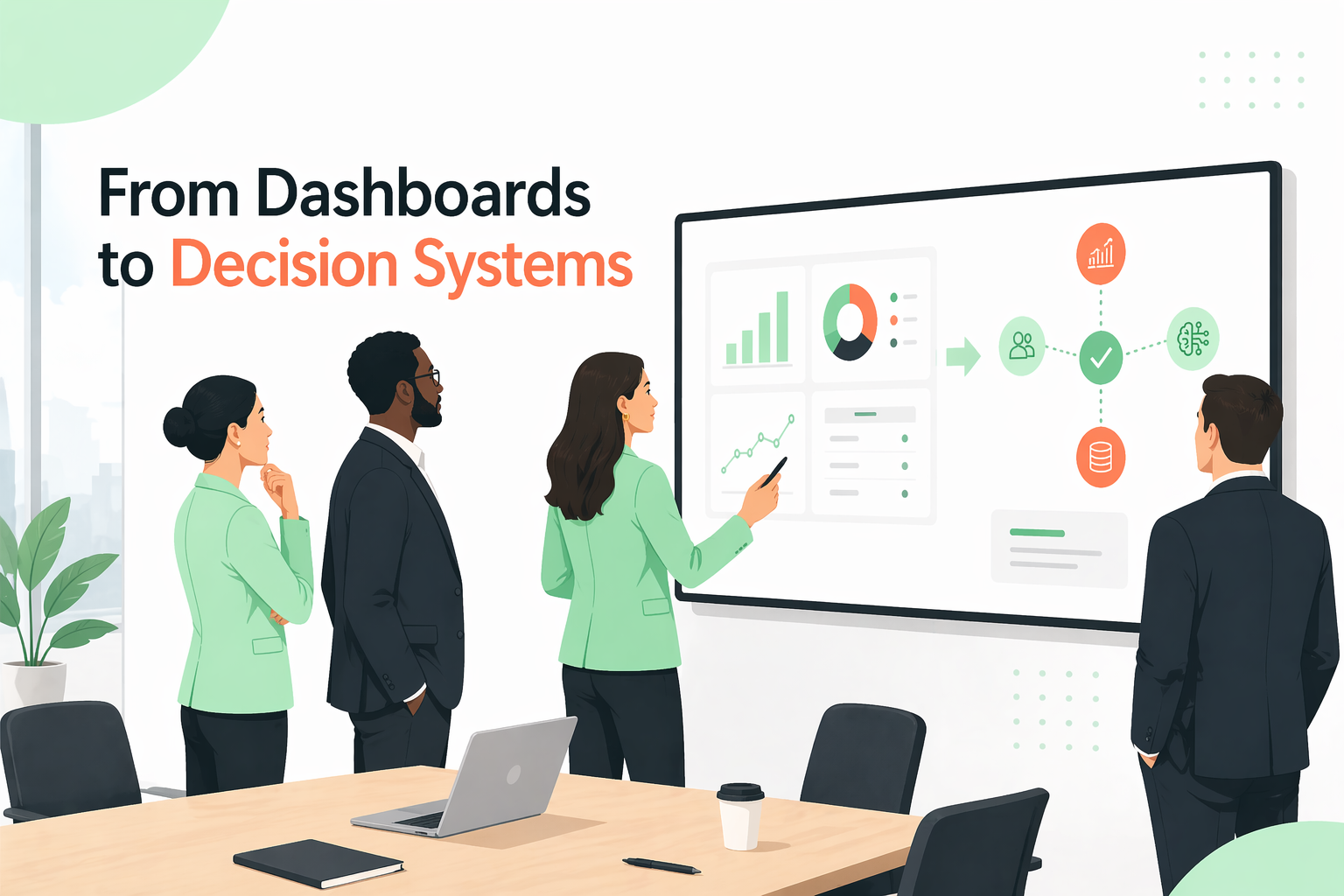
Another shift happening in BI is what companies actually expect as output. A few years ago, dashboards were enough. Today, they’re baseline—and often insufficient.
Dashboards present pre-defined views of data. But business questions change constantly. As soon as context shifts, static dashboards become limiting. This is why RevOps and finance teams still fall back on spreadsheets to answer basic questions about CAC, churn, or cash position.
The issue isn’t a lack of tools—it’s a lack of flexible, unified data. This is where AI is starting to reshape the workflow. Instead of building dashboards for every question, companies are moving toward systems where stakeholders can ask questions directly and get answers in real time.
In that model, the BI role shifts upstream. The value is no longer in building reports—it’s in ensuring the underlying data and logic are correct, consistent, and aligned with how the business operates.
AI Loves Data—But Struggles to Structure It
There’s an important nuance in the AI conversation that often gets missed. AI is incredibly effective at generating insights—but only when the data it’s working with is clean, consistent, and properly modeled. AI loves structured data. It struggles with defining that structure in the first place.
Data modeling is not just a technical exercise—it’s a contextual one. It requires understanding how the business actually operates, how different systems represent the same concepts, and how metrics should be defined in a way that leadership can trust. Much of this knowledge is not explicitly stored in the data—it lives in tribal knowledge across teams.
We saw this firsthand at DDAI.
Early on, we expected AI to help us accelerate the creation of our Common Data Model. In practice, it wasn’t nearly as effective as we anticipated. The challenge wasn’t transforming data—it was interpreting it. HubSpot, Stripe, and QuickBooks all represent customers, revenue, and timing differently, and those differences require human judgment to reconcile.
We ultimately relied on experienced data engineers to design and validate our unified model, because getting it right required more than pattern recognition—it required understanding intent.
As more companies adopt AI-driven analytics, this becomes even more important. If the data isn’t structured correctly, AI will produce answers that are fast—but wrong. That’s what’s driving demand for analysts who can bring structure, consistency, and clarity to complex data environments.
What Actually Makes Candidates Stand Out
This shift is reflected in hiring. The candidates who stand out are not the ones who know the most tools—they’re the ones who can think end-to-end. They understand how raw data becomes a structured model, how that model produces metrics, and how those metrics drive decisions.
This is why real-life projects matter more than certifications. Certifications show familiarity with a tool. Projects show the ability to solve real problems.
Why BI Remains a Strong Career Path
AI is not replacing BI—it’s raising the bar for it. As more companies rely on AI to generate insights, the importance of having a clean, well-structured data foundation increases. That creates demand for analysts who can bridge the gap between raw data and business decisions.
The role is evolving from dashboard builder to something closer to a hybrid of analyst, data modeler, and business translator. The tools will change. AI will accelerate workflows. But the ability to structure data, define metrics, and connect analysis to decisions is what will continue to make BI careers both durable and valuable.
