
AI Loves Data — But It Doesn’t Fix It
Why AI Feels So Powerful Right Now
One of the core reasons AI feels like such a step change is simple: it can process massive amounts of data instantly. What used to take hours of querying, exporting, and stitching together can now happen in seconds with a single prompt.
Ask a question, get an answer. That’s the promise.
For business teams—especially RevOps and finance—this feels like a breakthrough. The bottleneck has always been access to data and the time it takes to turn it into something usable. AI appears to remove both.
But there’s a catch.
AI Doesn’t Understand Your Business—It Understands Your Data
AI is only as good as the data it sits on top of.
It doesn’t inherently understand what “revenue” means in your company. It doesn’t know whether CAC should include payroll. It doesn’t know when a deal should count, or when cash is actually real. It simply interprets patterns and structures from the data it’s given.
This is where things get subtle—and where most teams get tripped up.
If your data is clean, consistent, and aligned to how your business operates, AI feels magical. Answers come back instantly, and they make sense.
If your data is fragmented across systems with conflicting definitions, AI still gives you answers—but now they’re fast, confident, and often wrong in ways that are harder to detect.
More Data ≠ Better Answers
There’s a common assumption that more data makes AI better.
In reality, more data often makes things worse—because it increases the surface area for inconsistency.
Consider a typical RevOps setup:
HubSpot tracks pipeline and deal stages
Stripe tracks subscriptions and payment timing
QuickBooks reflects actual cash movement
Each system is correct within its own context. But they don’t naturally agree.
When AI is layered on top of this environment without alignment, it doesn’t reconcile the differences. It amplifies them. You don’t get a single version of the truth—you get multiple plausible answers, each rooted in a different interpretation of the data.
This is why so many teams still double-check AI outputs in spreadsheets. Not because they don’t trust the technology, but because they don’t trust the underlying data.
Why Enterprises Get More Value from AI
This is also why AI appears to “work better” in enterprise environments. It’s not because the models are different. It’s because the data is.
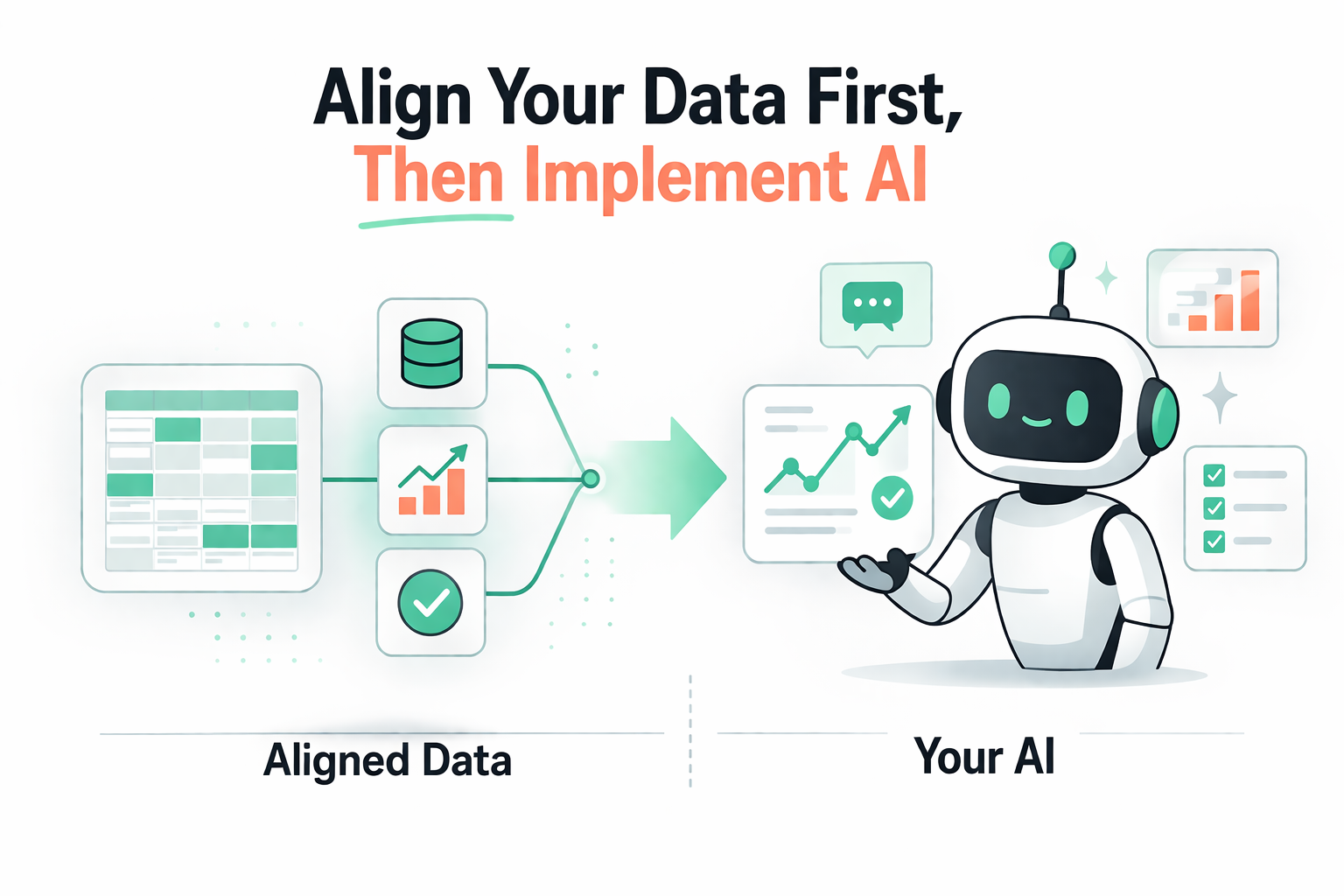
Large companies invest heavily in building data pipelines, defining metrics, and maintaining semantic layers that standardize how the business is represented in data. By the time AI is introduced, the hard work is already done. The system knows what CAC means. It knows how revenue should be calculated. It knows how systems relate.
AI isn’t solving the problem—it’s benefiting from a problem that’s already been solved.
The Real Opportunity: Aligned Data First, AI Second
For most companies, the opportunity isn’t just adopting AI. It’s getting the data layer into a state where AI can actually be trusted.
That means:
Consistent definitions across systems
Alignment between pipeline, revenue, and cash
A shared model of how the business operates
Only then does AI become what it’s supposed to be: a fast, reliable interface to the truth.
This is the shift that matters. Not from dashboards to AI, but from fragmented data to aligned data.
Where This Leaves RevOps
RevOps teams sit directly in the middle of this challenge. They’re expected to answer the most important questions in the business—runway, CAC, growth efficiency—but they’re working across systems that weren’t designed to work together. AI doesn’t remove that responsibility. If anything, it raises the stakes. Answers come faster, but so do mistakes.
The teams that get the most value from AI won’t be the ones that adopt it first. They’ll be the ones that prepare their data for it.
Because AI doesn’t fix your data. It exposes it.
