
Why the Future of AI Isn't About Better Models—It's About Better Data Foundations
A recent Substack article, Everyone's Watching the Wrong Benchmark, argues that the AI industry is focused on the wrong competition. While much of the conversation revolves around which large language model tops the latest benchmark, the real competitive advantage is quietly shifting elsewhere—to proprietary enterprise data and the operational knowledge organizations accumulate over years of running their businesses.
It's an insightful perspective, and one that resonates strongly with what we're building at Data Discourse AI (DDAI).
The article argues that the next generation of AI won't be defined solely by larger models or incremental improvements in reasoning. Instead, competitive advantage will come from trusted, proprietary data that reflects how organizations actually operate. Frontier AI labs are investing billions not simply to build better algorithms, but to acquire high-quality data and expert knowledge that cannot be scraped from the public internet.
For business leaders, this changes the conversation.
The question is no longer, "Which AI model should we use?"
The more important question is, "What business knowledge are we giving AI access to, and is that knowledge organized in a way that creates value for our company?"
Models Are Becoming Commodities
Over the past few years, AI discussions have centered on the capabilities of the models themselves. GPT-4, Claude, Gemini, Llama, DeepSeek, and others compete on benchmarks measuring reasoning, coding, mathematics, and language understanding.
Those benchmarks are useful, but they don't reflect how AI creates value inside an enterprise.
Executives aren't concerned with whether one model scores slightly higher than another. They want reliable answers to questions like:
What is our true ARR?
Why is pipeline slowing?
Which marketing channels generate the most profitable customers?
How much runway do we have if bookings decline by 15%?
Which customer segments have the highest expansion potential?
These aren't AI problems.
They're data problems.
The Enterprise Doesn't Have an AI Problem. It Has a Data Problem.
Growing SaaS companies rarely suffer from a lack of data.
They suffer from fragmented data.
Revenue lives in Stripe. Pipeline lives in HubSpot. Financials live in QuickBooks. Marketing metrics come from another platform. Customer success has its own systems.
Every application tells part of the story, but none tells the whole story.
The result is familiar: executives spend hours reconciling spreadsheets, debating metric definitions, and questioning whether the numbers in front of them can actually be trusted.
This challenge existed long before generative AI. AI simply makes it impossible to ignore.
An AI assistant is only as good as the information it receives. If the underlying business data is inconsistent, incomplete, or disconnected, the quality of the answers will reflect those limitations.
Better AI begins with better data.
Your Competitive Advantage Is Your Business Knowledge
One of the article's most interesting ideas is that proprietary workflows are becoming one of an organization's most valuable assets.
Every company develops unique ways of acquiring customers, forecasting revenue, measuring performance, pricing products, and operating the business.
That's institutional knowledge.
Unfortunately, much of it remains trapped inside disconnected systems, spreadsheets, and the experience of individual employees.
Without structure, AI can't reliably reason over it.
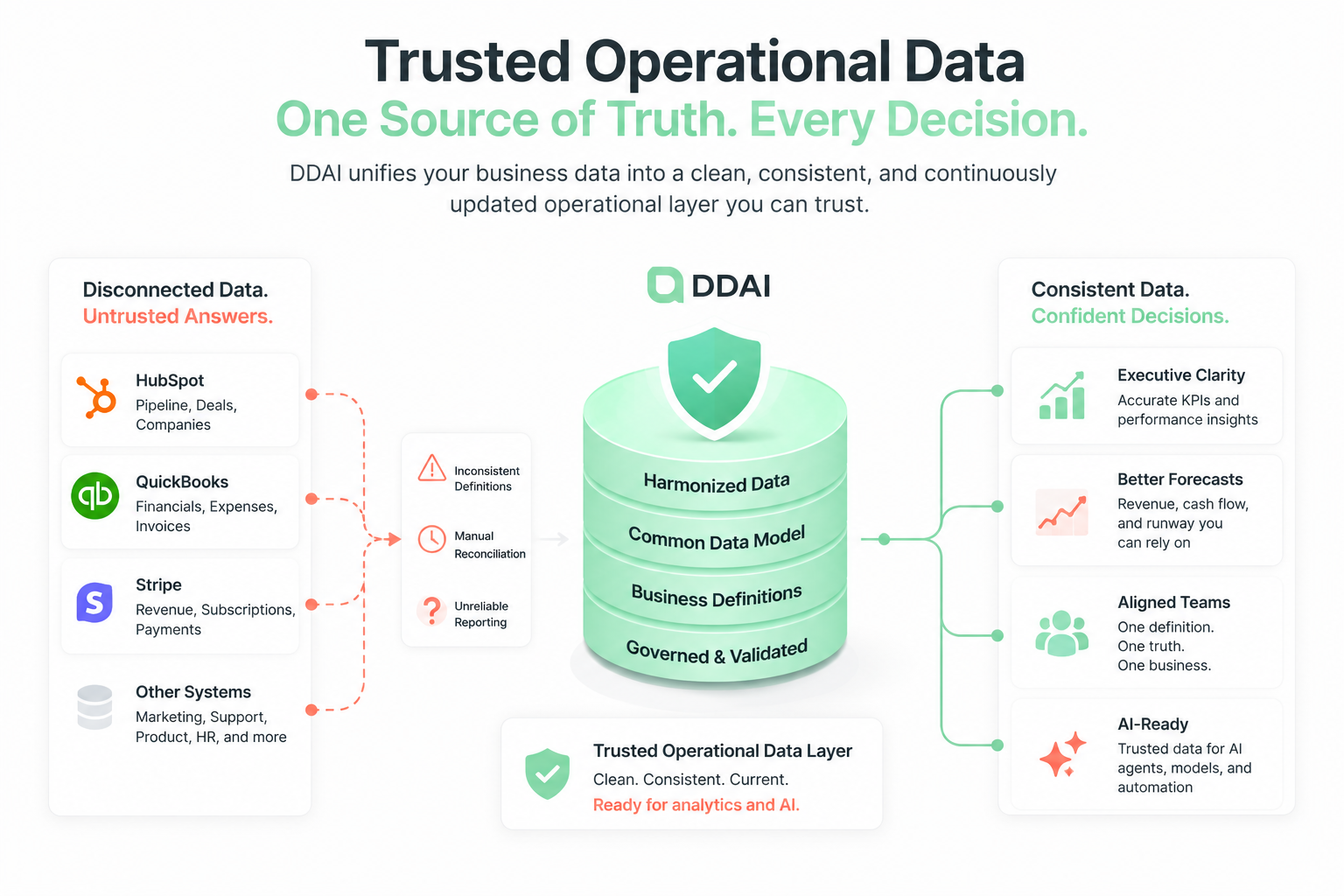
This is why semantic models and operational data layers are becoming foundational infrastructure for modern businesses. They transform fragmented operational data into a consistent representation of how the business actually works.
Metric definitions become standardized. Business terminology becomes consistent. Relationships between customers, revenue, finance, sales, and marketing become explicit rather than implied.
That creates an environment where both people and AI systems can make better decisions.
AI Doesn't Replace the Data Foundation
Some organizations assume AI eliminates the need for traditional data infrastructure.
We believe the opposite is true.
As AI becomes embedded in everyday business operations, a trusted data foundation becomes even more important.
At DDAI, we don't believe growing companies should have to build an enterprise data stack before they can benefit from AI.
That's why we built a managed AI-ready data platform that automatically integrates operational systems such as HubSpot, QuickBooks, Stripe, and other business applications into a unified operational data layer.
Instead of spending months building data warehouses, ETL pipelines, semantic layers, and reporting infrastructure, companies start with a trusted foundation already designed for reporting, forecasting, business intelligence, and AI.
Once that foundation exists, organizations can access it however they choose.
Some teams prefer Power BI or Tableau.
Others use Excel.
Increasingly, many want to work through ChatGPT, Claude, custom AI agents, or conversational analytics.
The interface matters far less than the quality of the data beneath it.
The Future Is Model-Agnostic
Businesses no longer want to be locked into a single AI provider.
Today's best model may not be tomorrow's best model.
That reinforces another principle behind DDAI: your data foundation should remain independent of whichever AI model happens to be leading the market.
When operational data is clean, governed, and consistently structured, organizations gain flexibility. They can connect new BI tools, experiment with different AI agents, build internal applications, and adopt future technologies without rebuilding their data infrastructure.
Their data becomes a long-term strategic asset rather than a dependency tied to a single vendor.
The Real Benchmark That Matters
Perhaps the biggest takeaway from the article is that the industry may be measuring the wrong thing.
Public AI benchmarks are interesting, but they don't determine whether executives trust their forecasts. They don't reconcile finance with sales. They don't align RevOps around consistent definitions of ARR, churn, or pipeline health.
Those outcomes depend on something much more fundamental: trusted operational data.
We believe the organizations that benefit most from AI over the next decade won't necessarily be those using the most advanced models. They'll be the ones that invested in building a reliable, governed, AI-ready foundation for their business knowledge.
Models will continue to evolve.
Interfaces will continue to change.
But trusted data will remain the foundation upon which every meaningful AI application is built.
That's the future we're building toward at DDAI—not another dashboard or chatbot, but the operational intelligence layer that gives growing SaaS companies enterprise-grade data infrastructure without enterprise complexity.
Because in the age of AI, the most valuable asset isn't simply access to better models.
It's owning a trusted understanding of how your business actually works.

