
What Databricks’ $6.9 Billion Run Rate Says About the Future of AI
The AI conversation has spent the last three years focused on models. Which model is smarter? Which agent is more capable? Which copilot will transform work?
But beneath the headlines, a different story is unfolding. The companies creating the most value from AI are not simply buying AI tools. They are investing heavily in the infrastructure required to make AI useful.
That reality is reflected in the remarkable growth of companies like Databricks. According to CNBC, Databricks recently reached a $6.9 billion annualized revenue run rate while growing revenue more than 80% year over year.
The scale of that growth is significant not simply because of what it says about Databricks, but because of what it says about the broader market.
Organizations are increasingly realizing that while AI models are becoming more accessible, trusted business data remains difficult to build and maintain. AI is only as valuable as the data behind it.
The Real AI Bottleneck Isn't AI
The dominant narrative around AI assumes that the primary challenge is access to advanced models. For most companies, that is no longer true. Organizations can access world-class AI capabilities through OpenAI, Anthropic, Google, Microsoft, and dozens of emerging providers. The models continue to improve at a remarkable pace.
What has not improved nearly as fast is the quality and accessibility of business data. Ask an executive where critical business information lives and the answer is rarely simple.
Revenue data sits in Stripe or Paddle. Pipeline data lives in HubSpot or Salesforce. Financial performance resides in QuickBooks or NetSuite. Marketing data lives in Marketo, ActiveCampaign, or Google Ads. Customer information is scattered across support platforms, spreadsheets, and operational databases.
The problem is no longer intelligence. The problem is context.
Why Data Infrastructure Is Becoming the Biggest AI Investment Category
What makes Databricks' growth particularly interesting is that it coincides with a period when AI models themselves are becoming increasingly accessible. As access to AI becomes commoditized, spending is shifting toward the infrastructure required to make AI useful inside businesses.
Organizations are realizing that before AI can answer questions, automate decisions, or power intelligent workflows, it must first understand the business. That requires trusted data.
Enterprise organizations have spent years solving this challenge. They build data warehouses. They hire data engineers. They implement data pipelines. They create governance frameworks. They invest millions creating a single source of truth that can support analytics, reporting, forecasting, and AI initiatives.
Without a trusted foundation, AI produces answers that sound convincing but cannot be trusted. That is unacceptable when the questions involve revenue forecasts, cash flow, customer acquisition costs, churn, profitability, or strategic planning.
As AI adoption accelerates, the value of operational data infrastructure rises alongside it. The winners of the AI era may not be the companies building the most sophisticated models. They may be the companies creating the most reliable data foundations.
Most Companies Are Not AI Ready
Many organizations believe they have an AI strategy because they have deployed ChatGPT, Copilot, or another AI assistant. The harder question is whether their structured business data is prepared for AI consumption.
AI readiness requires more than model access. It requires unified, trustworthy, and accessible business data that can be used consistently across reporting, analytics, forecasting, and AI applications.
Without that foundation, AI simply amplifies existing data quality and reporting problems. This is why so many organizations are discovering that their first meaningful AI investment is not another model or agent. It is their data infrastructure.
The SMB Challenge
Small and mid-sized businesses face a unique problem. A SaaS company generating $5 million, $15 million, or even $30 million in annual revenue often faces many of the same reporting challenges as a Fortune 500 company. Leadership still needs answers to questions like:
What is our true customer acquisition cost?
Which channels generate the highest lifetime value customers?
How does pipeline performance impact runway?
What is our forecasted cash position three months from now?
Which customer segments generate the highest margins?
AI is creating an unusual dynamic. The gap between enterprise and SMB access to AI models is shrinking, but the gap between enterprise and SMB data infrastructure remains enormous.
Most growing companies need the outcome of an enterprise data stack without the cost, complexity, and maintenance burden of building one themselves.
The Opportunity Ahead
This is where the market is beginning to evolve. Companies increasingly want a trusted operational data layer that unifies information across sales, marketing, finance, and customer systems. They want AI-ready data. They want reliable reporting and forecasting. They want cross-functional visibility. But they do not want to build and maintain the underlying infrastructure themselves.
That is the problem DDAI was designed to solve.
DDAI integrates data from HubSpot, QuickBooks, Stripe, and other business systems into a continuously updated operational data layer built on a Common Data Model. The result is a trusted, AI-ready source of truth that teams can access through BI tools, AI agents, custom applications, or conversational analytics.
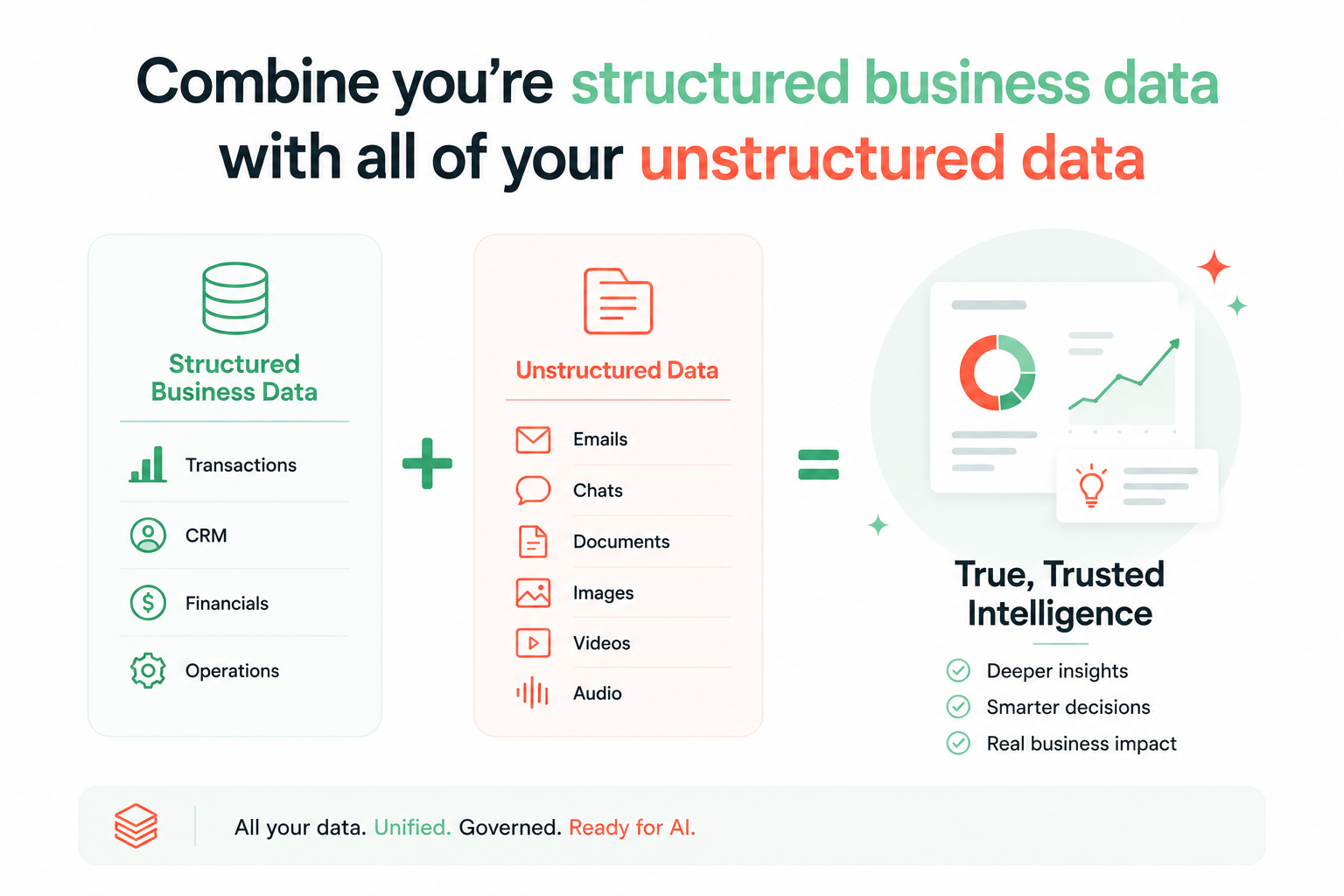
That foundation becomes even more valuable when combined with unstructured business knowledge such as Google Drive, SharePoint, Notion, meeting transcripts, contracts, presentations, and support documentation. Together, structured and unstructured data give teams and AI systems the context needed to deliver better answers, better decisions, and a clearer understanding of the business.
The broader lesson from Databricks' growth is not that every company should become a data infrastructure company. It is that every company needs data infrastructure.
And Databricks' growth is one of the clearest signals that this shift is already underway.
