
Decisions at the Speed of Thought
The Data Stack Is Moving Up the Value Chain
For the past decade, the modern data stack has centered on the cloud data warehouse, with platforms like Snowflake, BigQuery, and Redshift forming the foundation for storing, processing, and analyzing business data. Around this core, an ecosystem of ingestion tools, transformation frameworks, and BI dashboards emerged, making the warehouse the gravitational center of the data ecosystem.
The Traditional Data Stack: Built Around the Warehouse
The modern data stack that emerged during the 2010s followed a clear structure:
ETL / ingestion tools (e.g., Fivetran, dbt)
Data warehouse (e.g., Snowflake)
BI tools (Tableau, Looker, Power BI)
Business users (Execs, shareholders)
Operational data from systems like CRM, finance, marketing, and product platforms was extracted and loaded into a centralized warehouse. Transformation layers such as dbt modeled the data into usable structures, and BI tools turned those models into dashboards.
In this architecture, the warehouse sat at the center. Snowflake became one of the defining platforms of this era, enabling organizations to scale analytics in ways that were previously impossible. For data teams, this model worked fine. But this approach was costly, requiring organizations to maintain full data teams to manage pipelines, models, and reporting. While the system organized information efficiently, it stopped short of delivering what business users actually needed—it did not directly explain what was happening in the business.
The Emerging AI Data Stack
Now AI is changing the interface between humans and data. Instead of navigating dashboards, users want to ask questions and receive clear, contextual answers. This shift is reorganizing the architecture of the data stack.
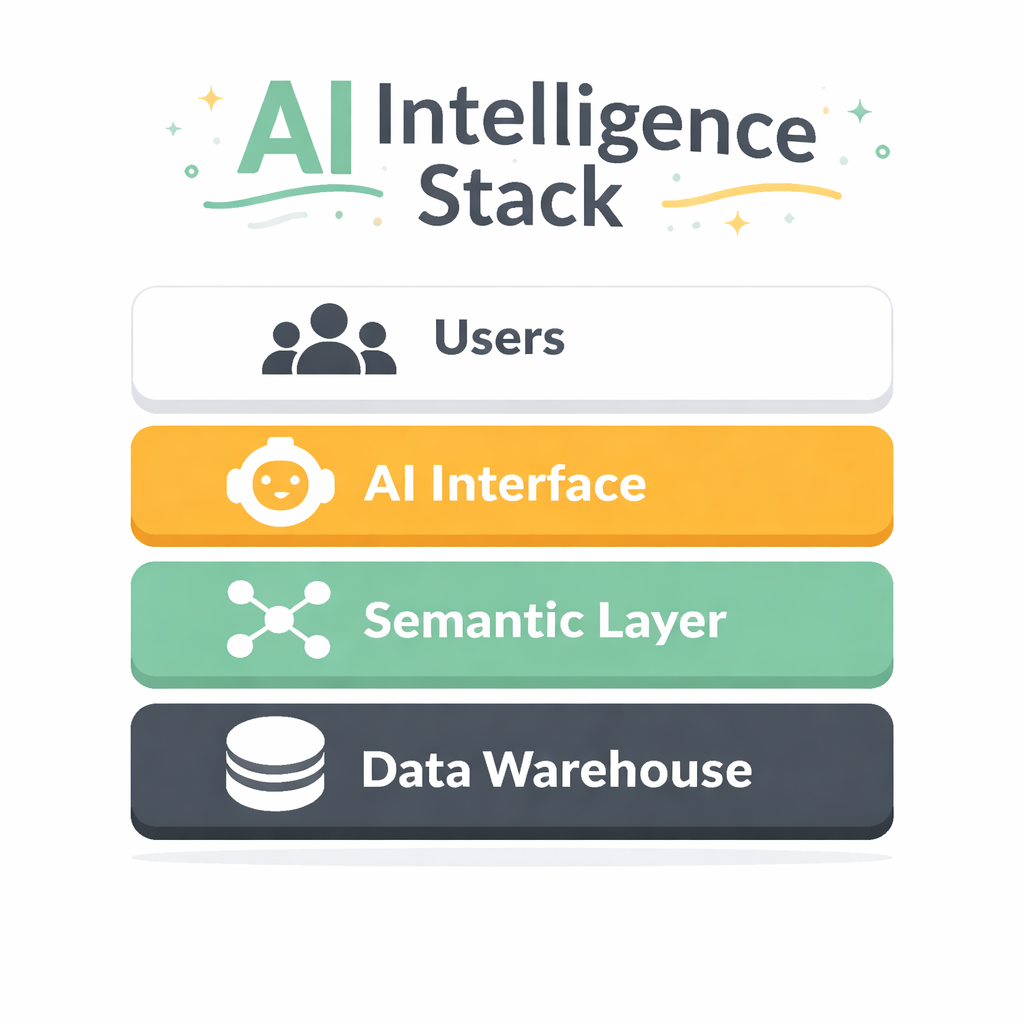
The emerging structure looks like this:
Users
AI interface
Semantic layer
Data warehouse
The warehouse remains the foundation and system of record. But above it sits a semantic layer that defines the meaning of the business—metrics, entities, and relationships. On top of that sits an AI interface that translates questions into answers. Users no longer navigate data systems. They interact with an intelligence layer.
The Stack Is Collapsing Upward Toward Intelligence
The data stack is not just evolving—it is compressing upward, and the reason is straightforward: value accumulates where users are. Business users do not interact with infrastructure. They do not see ETL pipelines, warehouses, or query engines. To them, these layers are effectively invisible and, increasingly, irrelevant. What they care about are outcomes—understanding what is happening in the business, why it is happening, and what actions to take next. This shift in user expectation is what is driving the reorganization of the stack.
The emerging architecture reflects this clearly: infrastructure at the base, a semantic layer that defines the business, and above it an AI interface that delivers answers directly to users. This top layer—where users engage, ask questions, and receive explanations—is what defines the AI intelligence layer.
The AI Intelligence Layer
Data Discourse AI (DDAI) is the direct application of this shift to business intelligence. It is not another BI tool, but an AI BI operating layer—a system that sits above the warehouse and core business systems such as HubSpot, QuickBooks, and Stripe, and translates data into answers for operators. Instead of navigating dashboards or relying on expensive data teams, leaders interact directly with the data. They ask questions, and the system explains what is happening in the business in clear, contextual terms — with no need to understand the supporting infrastructure below.
The Products That Win Will Own this Intelligence Layer
As AI becomes the primary interface for interacting with data, value shifts away from infrastructure and toward the intelligence layer—the system that understands data and delivers outcomes. The companies that win will control both the semantic understanding of the business and the AI interface used by decision-makers, effectively owning how a company interprets its performance, risks, and opportunities. This reflects a broader pattern in software evolution: value concentrates at the layer closest to the user. While the warehouse remains essential, it is not where competitive advantage is won—the winners will be platforms that sit above it, transforming data into decisions at the speed of thought.
