
The Great SaaS Compression: the Shrinking Software Stack and the Rise of the Intelligence Layer
AI Is About to Reshape the SaaS Stack
For decades, the SaaS industry has followed a predictable trajectory: more software, more tools, and more seats. At the center of the stack are platforms that store operational business data—CRM systems, marketing & financial systems, and payments infrastructure. Surrounding these systems is a long list of smaller tools that help teams coordinate work or extract insights.
Core, Operational SaaS
At the center of most company tech stacks are a handful of core systems of record—platforms like CRM systems (HubSpot or Salesforce), financial systems (QuickBooks or NetSuite), and payments platforms (Stripe or Square) that store the operational data of the business. These systems track customers, revenue, transactions, and financial records, becoming the authoritative data for how a company actually operates. These large SaaS platforms expanded revenue through seat-based pricing, selling licenses to growing numbers of knowledge workers inside midsize businesses and enterprises.
Long Tail SaaS
At the same time, every new operational problem created an opportunity for a new SaaS product. Teams adopted specialized platforms for project management, workflow automation, reporting, collaboration, integrations, and niche operational tasks. Over time, companies accumulated dozens of these tools across departments. The long tail grew because SaaS dramatically lowered the cost of building and distributing software. Startups could solve narrow problems extremely well and sell directly to individual teams within organizations.
Two Flank Attack
Now AI is beginning to disrupt both dynamics — compressing the SaaS stack from two directions at once. At the edges, many long-tail tools that exist to automate simple workflows or move data between systems may disappear as AI agents replicate their functionality. At the same time core systems of record may feel economic pressure as AI reduces company headcount and the number of knowledge workers requiring a seat.
The result is a smaller, tighter SaaS stack. However as AI reduces the number of humans operating core systems, the operational CRM, financial, and marketing data they contain will become even more valuable in an AI-driven world.
Where AI Meets Canonical Data
As the long tail and seat counts shrink but systems of record remain foundational, a new opportunity emerges: an intelligence layer built on top of harmonized, canonical data.
AI Loves Data
AI works best when it operates on large volumes of harmonized, canonical data. That’s why companies like Snowflake and Databricks are so well positioned in the AI era. They sit at the center of the enterprise data layer, where information from systems of record—CRM, finance, payments, and operations—is consolidated and structured. Because AI systems depend on high-quality data to generate insights and automate decisions, the platforms that organize and process this operational data become increasingly valuable. In an AI-driven world, the infrastructure closest to canonical business data becomes some of the most durable and strategically important software in the stack.
Great Infrastructure… If You Have a Data Team
But even with powerful platforms like Snowflake and Databricks in place, many companies struggle to fully benefit from them. Extracting meaningful insights still requires teams of data engineers, architects, and data scientists to pull data from multiple systems, transform it into a usable structure, model it for analysis, and build and maintain the pipelines that keep the data accurate and up to date—often alongside BI tools and SQL-based analytics layers used to surface the final insights.
The infrastructure for storing and processing data exists, but for many organizations, actually getting answers is out of reach due to the significant manual effort and investment
The Rise of the AI Intelligence Layer
Out of this disruption, a new category of software will emerge: AI-powered intelligence layers built directly on top of canonical data. Core systems of record will continue to generate the operational data of the business, while platforms like Snowflake and Databricks provide the infrastructure to securely store, scale, and organize that data in modern data warehouses. The opportunity now shifts to software that can make this data usable for operators without the cost and complexity of a traditional data stack.
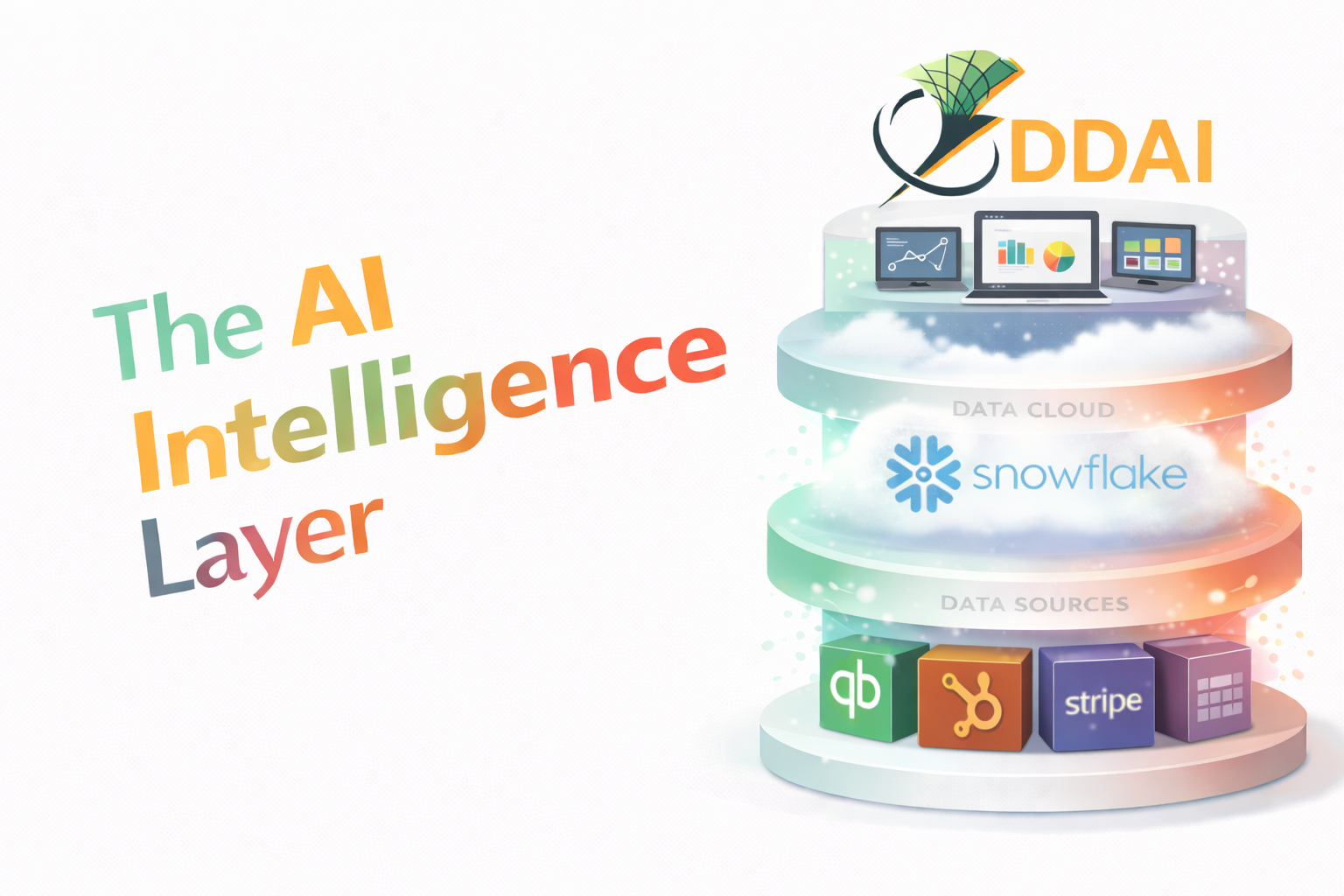
The next generation of analytics platforms will not simply visualize data. They will own the entire pipeline required to make that data useful—extracting it from core systems, transforming and harmonizing it into a consistent structure, and maintaining the pipelines that keep it accurate and continuously up to date.
The AI Analyst for Your Business
This is where Data Discourse AI (DDAI) comes in.
DDAI sits on top of data from the systems that actually run a company—platforms like HubSpot, QuickBooks, and Stripe—and handles the heavy lifting of extracting, harmonizing, and structuring that data into a unified operational model. Instead of relying on teams of engineers to build pipelines, maintain dashboards, and stitch together reports, DDAI manages the full data pipeline behind the scenes.
On top of that foundation sits a natural-language AI interface into the harmonized, canonical data. No dashboards. No SQL. No waiting for analysts. Operators simply ask questions and get answers instantly. The result is something amazing and much simpler than traditional analytics: a direct conversation with the truth of the business.
The Future SaaS Stack: Smaller, Tighter, More Intelligent
The SaaS stack of the last decades was built on expansion—more tools, more dashboards, more seats. AI is about to reverse that trend. Much of the long tail of SaaS is toast as AI agents absorb the workflow, reporting, and integration tasks those tools were built to handle. At the same time, fewer knowledge workers means fewer seats across CRM, marketing, finance, and operations platforms.
But while the human layer shrinks, the data layer becomes more valuable than ever. Systems like HubSpot, QuickBooks, and Stripe each hold the operational records for their domain—customers, financials, and payments. The challenge is that this data lives in silos. Platforms like Snowflake and Databricks are ideally positioned to securely centralize and scale that data, while intelligence-layer software like DDAI extracts, transforms, and harmonizes it into a unified operational model. The result is a single, canonical view of the business—one that operators can access through a simple AI-powered interface to generate answers, insights, and decisions in real time.
The game is changing and DDAI is here to play
👉Want to learn more? Book a demo.
Craig
