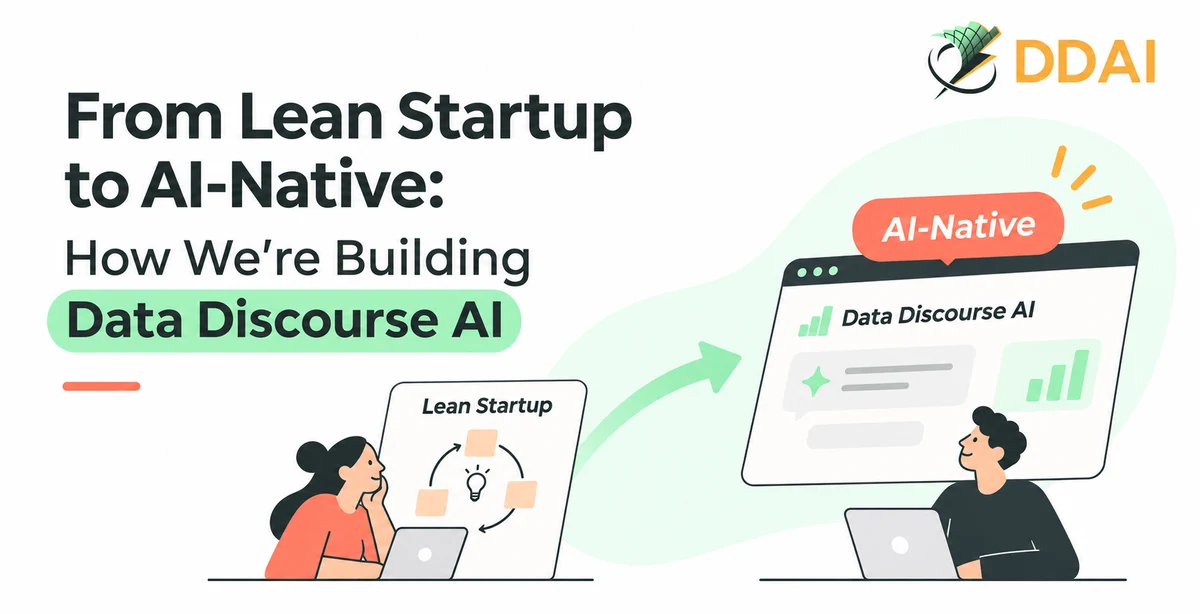
I’ve come to believe that becoming an AI-native company has very little to do with how many AI tools you use. It’s about how you divide the work between people and machines.
At Data Discourse AI (DDAI), we follow a straightforward operating rule: Humans decide. AI and agents execute.
For us, being AI-native means organizing the company around human judgment and AI execution. We make the strategic and operational decisions, while AI agents carry out the work under human oversight.
Strategy, positioning, product direction, and customer-facing decisions remain human responsibilities. Building, writing, operating, and maintaining the systems that support those decisions increasingly belong to AI, with human oversight.
My co-founder, Michael Hanna, and I divide those responsibilities naturally. I focus on the what: what we’re building, who we’re serving, and where we’re taking the business. Michael owns the how: the technical architecture and engineering decisions that make it possible.
From Outsourced MVP to AI-Native Engineering
Our first version of DDAI followed a familiar startup playbook. We hired two outsourced development teams, one for the front end and another for data engineering. We invested approximately $75,000 to build our MVP.
It worked, but the architecture was rigid and difficult to scale. Every meaningful change required another vendor conversation, development cycle, and invoice. We had a functioning product but lacked the flexibility to evolve it quickly.
So we brought development in-house, beginning our AI-native transformation.
Michael led the engineering migration, using Replit to manage the application front end and Claude Code to manage data engineering through Foundry, our proprietary multi-agent data engineering system. Michael directs the technical architecture and engineering decisions while AI handles much of the execution.
The improvement has been substantial. Our platform is more scalable, reliable, and adaptable. We can make changes quickly without coordinating outsourced development cycles.
With the product now market-ready, we’re applying the same model to our go-to-market operations.
Building a Headless Marketing Operation
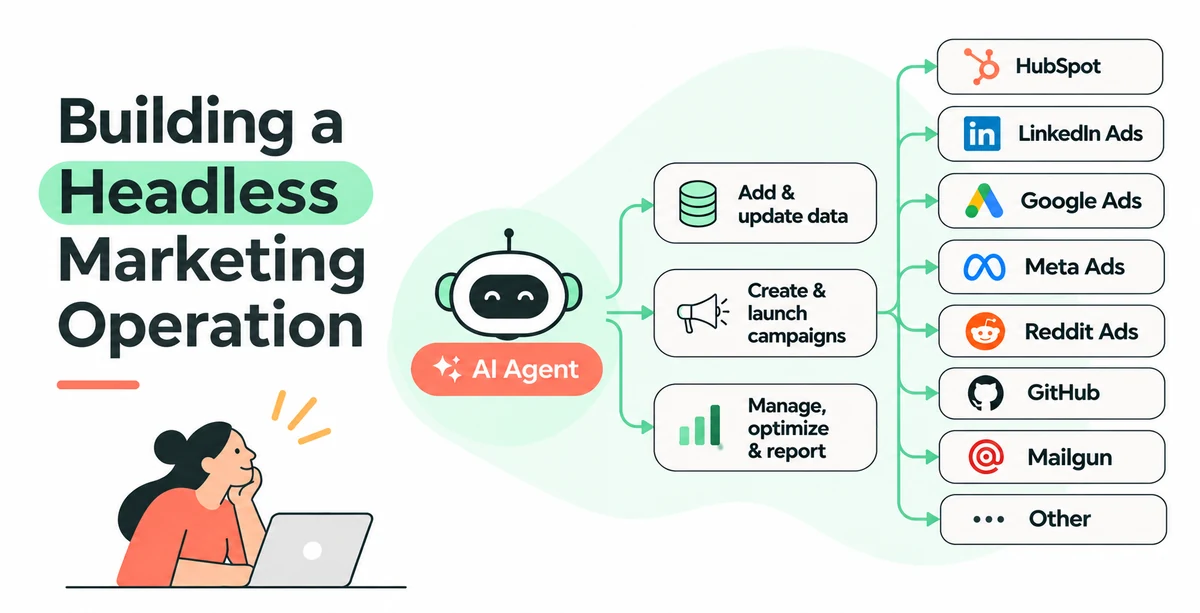
We’re completing a headless marketing operation spanning inbound and outbound.
I designed the inbound system and built it with Michael. I defined the processes and workflows, while Michael engineered the backend automation connecting our data flows, email triggers, and integrations across the DDAI application, GitHub, Mailgun, and HubSpot.
I then configured Muse, my AI agent, to operate the system.
Muse manages advertising across LinkedIn, Reddit, Google Ads, and Meta, including creative, landing pages, and campaign execution. It also coordinates our blog and social editorial workflows. I retain control over strategy, budgets, targeting, and final content approval.
The advertising platforms are operated headlessly. AI handles the clicking, monitoring, and reporting without someone manually working through each interface.
Our website operates similarly. Muse makes changes, but nothing is published without human initiation, review and approval.
HubSpot: Our Headless System of Record
Muse and I configured HubSpot to track our complete opportunity lifecycle, from initial engagement through qualification, sales progression, and signed contracts. We also built custom objects and properties specific to our business.
Comprehensive marketing attribution connects leads to their originating campaigns and follows their progression into opportunities and contracts. Downstream conversion data feeds back into the advertising platforms, enabling continuous optimization based on business outcomes rather than clicks alone.
HubSpot operates headlessly as our current system of record, connecting marketing, sales, and customer information.
Michael’s Proprietary Automation Layer
Michael engineered the automation connecting campaign activity, lead capture, qualification, and CRM updates into a coordinated workflow.
He also developed proprietary technology that evaluates incoming leads and determines how qualified they are, allowing the system to route opportunities consistently without manual screening.
The Outbound Engine
Outbound operates through ChatGPT, building target lists and landing pages, drafting personalized emails, and managing a three-email outreach cadence. Google Sheets tracks activity while HubSpot updates in real time.
Humans determine targeting and messaging. AI executes the approved workflow.
Behind these systems, Muse also works headlessly across Gmail, Google Docs, Drive, Sheets, Calendar, and HubSpot, preparing communications, organizing records, updating information, and producing briefs. External communications and changes to business records require my approval.
We’ve built these capabilities without hiring a marketing team, agency, or additional development shop. The significance isn’t simply cost savings. It’s the operating capacity we’ve created.
AI Changes the Economics of Capability
Historically, startups pursuing enterprise-scale capabilities relied primarily on human effort. Building sophisticated products, data infrastructure, and go-to-market operations required specialized teams, significant spending, and often venture funding.
AI fundamentally changes those economics. A small team of experienced operators can now accomplish work that previously required entire departments. At DDAI, we’re using AI to develop our application, manage data engineering, execute multichannel marketing, run outbound campaigns, and coordinate daily operations.
But humans remain responsible for decisions and outcomes, while AI and agents handle execution. Code, communications, marketing, and business operations still require human judgment and approval. That oversight isn’t something to automate away. It’s what makes the model trustworthy.
This is also the principle behind our product. We’re building an AI-native company with the capabilities of a much larger organization while giving our customers enterprise-grade, AI-ready data infrastructure without requiring an enterprise-sized data team.
The goal isn’t to replace people. It’s to fundamentally expand what a small, experienced team can achieve.