
RevOps Use Case Series (Part 5): Aligning Growth, Spend, and Profitability
By now, we’ve covered the foundational pillars of operational clarity.
Part 1 focused on executive reporting — establishing a trusted source of truth.
Part 2 addressed runway and cash forecasting — ensuring survival and planning confidence.
Part 3 examined unit economics — measuring efficiency.
Part 4 explored pipeline visibility — improving predictability.
Now we arrive at the capstone question:
Are our growth decisions actually improving the business?
This is where everything converges. Growth, spend, margin, and cash can no longer live in separate conversations. They must be evaluated together.
The Problem: Growth and Profit Rarely Live in the Same System
In most SaaS companies, growth is easy to see. Profitability isn’t.
HubSpot shows pipeline and closed-won revenue. Stripe shows subscriptions and payments. QuickBooks shows expenses and cash. Each system works on its own, but none of them answers the real question: is our growth making the business stronger?
Marketing sees pipeline up. Sales sees bookings up. Finance sees costs rising. Leadership gets three different stories.
So decisions are made in ambiguity. Spend increases because pipeline looks healthy. Hiring expands because bookings are strong. Discounts push deals over the line. A few months later, margins tighten or cash slows — and no one can clearly connect the dots.
The problem isn’t data. It’s alignment.
Where Alignment Breaks Down
Alignment falters when revenue lives in one report and costs live in another. Top-line growth is straightforward. The quality of that growth is not.
Which channels bring in profitable customers?
Which segments hold healthy margin after servicing costs?
Does faster acquisition improve the business — or just increase burn?
Answering that requires connecting marketing, revenue, and expense data. In most companies, that connection lives in spreadsheets. Over time, assumptions drift, definitions change, and reports stop matching.
Dashboards show activity. Spreadsheets show models. Neither shows the full, current picture of how growth decisions impact margin and cash. Consequently, companies can hit revenue targets while quietly weakening the business underneath.
What Leadership Is Really Asking
When executives ask about growth, they’re not asking for another pipeline report. They want to know if the company is becoming more durable.
If we increase spend, what happens to margin?
Where should we double down — and where should we pull back?
Can we scale revenue without creating financial strain?
Those are cross-system questions. They can’t be answered inside HubSpot alone or QuickBooks alone. They require revenue, cost, and cash to sit in the same view.
Without that, strategy is reactive. With it, strategy becomes intentional.
From Disconnected Metrics to Unified Business Logic
Alignment isn’t a reporting fix. It’s a systems fix.
DDAI connects HubSpot, Stripe, and QuickBooks into a unified data model, then layers a semantic interface on top. Instead of exporting and reconciling data manually, RevOps can evaluate growth in context.
You can see which channels are profitable after fully loaded CAC. You can view margin by segment, not just revenue. You can understand how increased acquisition affects runway and cash — using real expense data, not static budgets.
Because revenue and spend are connected, the impact of decisions is visible immediately. Growth stops being measured in isolation. It’s measured against margin, efficiency, and liquidity.
The Strategic Shift: Growth With Discipline
When growth, spend, and outcomes are connected, tradeoffs become clear. You can see when a channel drives volume but margin is weak. You can spot segments that convert slower but create stronger lifetime value. You can understand whether discounting helps — or hurts — long term.
RevOps moves from simply reporting to guiding where to allocate resources.
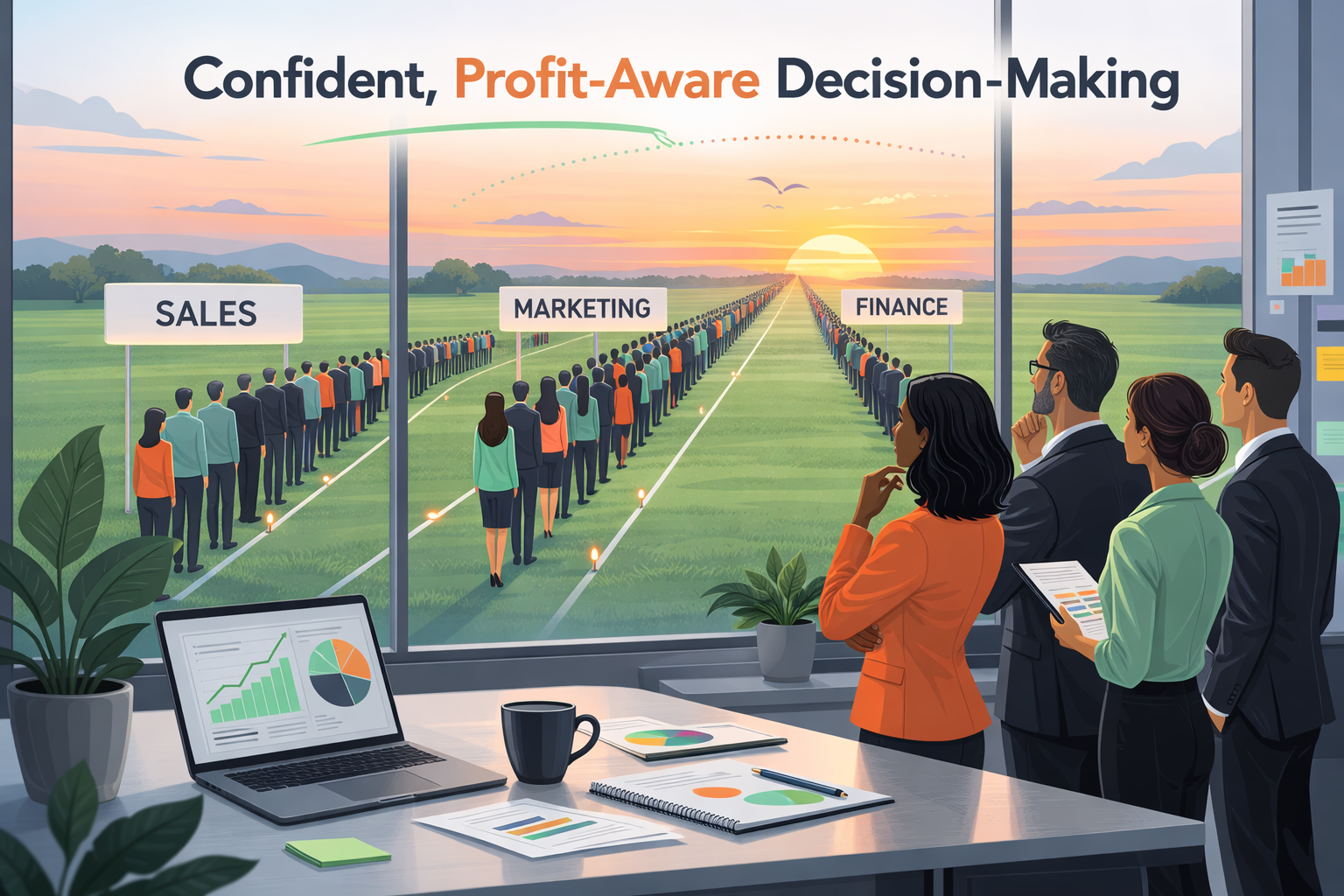
The Outcome: Confident, Profit-Aware Decision-Making
When data lives in silos, growth feels good — but uncertain. When data is unified, growth becomes deliberate. Conversations shift from opinions to evidence. Budget decisions become clearer. Capital gets allocated with confidence.
And leadership knows the company isn’t just growing — it’s growing in a way that strengthens the business.
From disconnected metrics to confident, profit-aware decision-making.
👉Want to learn more? Book a demo.
