
The Modern Data Stack Landscape — And Why Midmarket Companies Still Struggle With Data
Every growing company wants to become “AI-ready.” Leadership teams want faster answers about revenue, CAC, churn, profitability, pipeline health, and cash flow. But most midmarket businesses are still operating across disconnected systems, spreadsheets, and fragmented dashboards.
The issue is not a lack of data. It is a lack of unified operational infrastructure.
Revenue lives in HubSpot. Billing sits in Stripe. Financial reporting happens in QuickBooks. Marketing data might exist somewhere else entirely. As companies scale, reporting becomes slower, less trusted, and increasingly dependent on manual work.
This is the operational gap driving demand for the modern data stack — and why many companies still struggle to implement one successfully.
The Midmarket Data Problem
DDAI’s core market includes SaaS companies, agencies, tech-enabled businesses, and e-commerce operators managing multiple operational systems.
These companies face the same recurring problems:
Disconnected reporting across finance, sales, and marketing
Spreadsheet-heavy workflows
Slow ad hoc reporting
Conflicting KPI definitions
Limited visibility into cross-system performance
Poor AI readiness
Most know they need better operational visibility. Few have the internal data teams required to build enterprise-grade infrastructure from scratch.
That has created a fragmented competitive landscape.
The Competitive Landscape
Enterprise Data Stack Consultancies
Companies like Slalom, phData, Hakkoda, and InterWorks help organizations build modern data environments using Snowflake, dbt, and Fivetran.
These firms are valuable for enterprises with large budgets and internal data teams. But for many midmarket companies, the model is difficult to sustain. Implementations are expensive, highly customized, and dependent on ongoing technical resources.
RevOps and GTM Infrastructure Platforms
Platforms like Syncari, Von, Openprise, Hightouch, Census, and Clay focus on CRM synchronization, workflow automation, reverse ETL, and GTM orchestration.
These tools improve operational workflows, but they are not complete operational data platforms. Most assume the customer already has a warehouse strategy, harmonized data models, and underlying infrastructure in place. They solve movement and activation of data — not unified operational intelligence.
Conversational BI and AI Analytics
The rise of conversational analytics platforms like ThoughtSpot, Sigma, Omni, Seek AI, and Chata.ai reflects a major shift toward natural-language business intelligence.
But conversational interfaces are only as reliable as the underlying data foundation.
Most AI analytics platforms assume companies already have clean pipelines, semantic models, and unified operational datasets. For many midmarket businesses, that infrastructure simply does not exist. The interface is not the hard part. The operational data layer is.
Fractional Data Teams and Analytics Agencies
Many growing businesses turn to outsourced analytics teams and boutique consultancies for help building dashboards and reporting systems.
These firms can provide valuable expertise, but the work is often highly customized and difficult to scale. Over time, reporting infrastructure becomes dependent on external resources rather than productized systems.
The Biggest Competitor Is Inertia
For many businesses, the biggest competitor is not another software company — it is staying stuck. Modern data stacks often feel too enterprise-focused, too technical, and too expensive for midsize operators. As a result, companies continue relying on spreadsheets, manual exports, disconnected dashboards, and inconsistent reporting processes.
Many assume they need data engineers, warehouse architects, and large consulting engagements just to modernize operational reporting. Historically, they were mostly right.
How DDAI Fits Differently
DDAI is not trying to be another dashboard tool or AI chatbot layer.
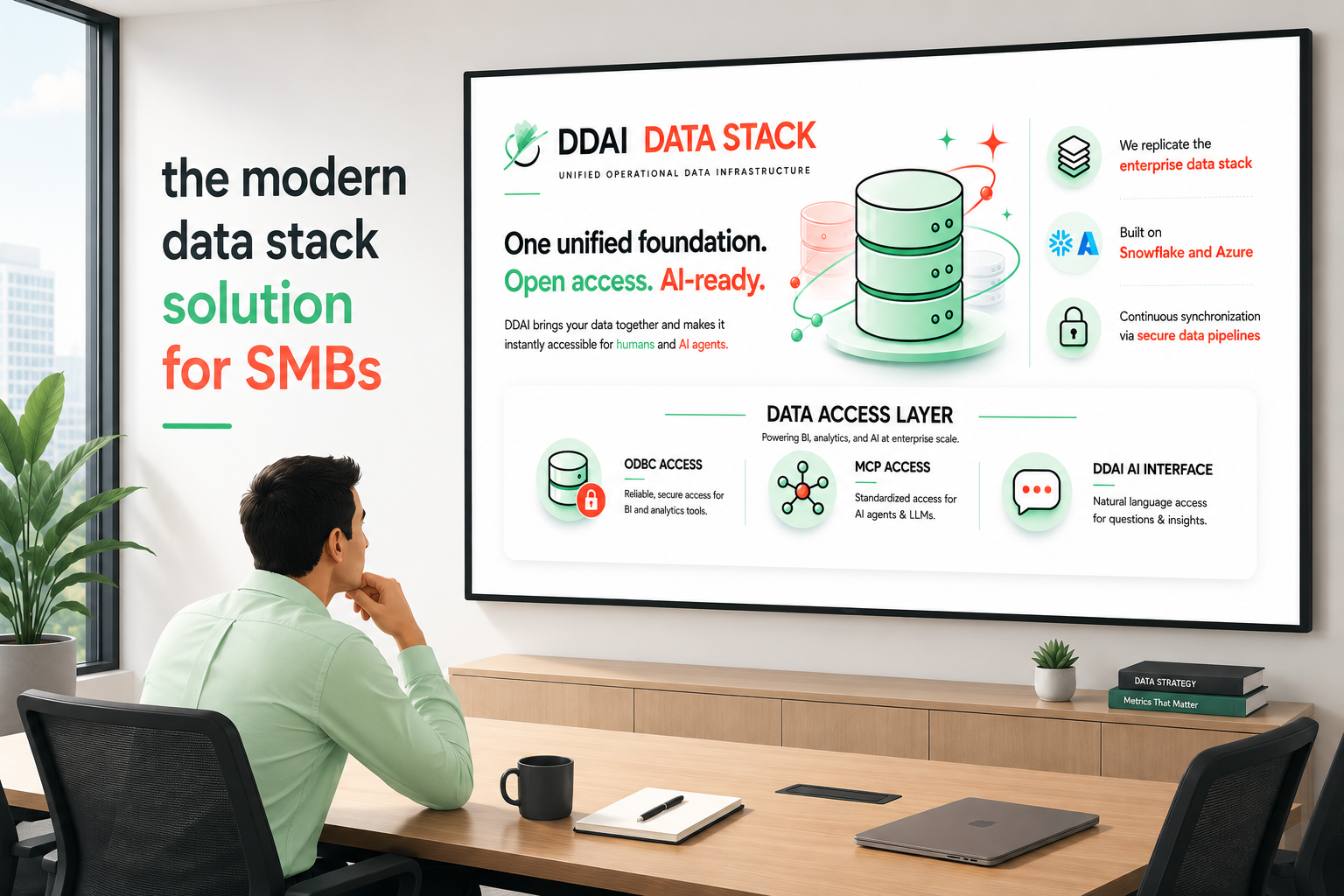
It combines managed operational data infrastructure, automated pipelines, harmonized common data models, semantic modeling, and natural-language analytics into a single operational platform.
DDAI connects HubSpot, QuickBooks and Stripe (with many more systems to come)into a centralized operational data layer that powers analytics, executive reporting, RevOps intelligence, and AI-ready workflows.
The goal is simple: Replicate the capabilities of an enterprise modern data stack — without requiring an enterprise data team.
That means:
No warehouse setup
No pipeline maintenance
No complex engineering overhead
Faster onboarding
Cross-system visibility out of the box
DDAI’s Common Data Model and semantic layer help unify fragmented operational systems into a consistent business view that leadership teams can actually trust.
Conclusion
The market is shifting away from isolated dashboards and toward unified operational data infrastructure.
Midmarket companies do not just need better reporting tools. They need AI-ready operational foundations that are accessible, affordable, and easy to operationalize.
That is the gap DDAI is designed to solve. We give growing companies enterprise-grade operational data infrastructure — without the enterprise overhead.
