Your MCP Server Isn't the Solution
Every week I see another post about MCP servers being a great way to analyze business data. The promise is compelling. Connect an AI model directly to your business system and suddenly you can ask questions in plain English. Well, you can but…
The problem is that most MCP implementations connect to only a single application like HubSpot, Stripe, QuickBooks, Salesforce, Netsuite, etc. The AI can access the data, but it still only sees one piece of the business. That's not an AI problem. It's not even an MCP problem. It's a data problem.
MCP Doesn't Eliminate Silos
A HubSpot MCP server can answer questions about CRM data. A Stripe MCP server can answer questions about subscriptions and payments. A QuickBooks MCP server can answer questions about accounting records. But most executive questions don't live inside a single system. The questions executives care about are cross-system questions.
CAC requires marketing spend and customer acquisition data.
Runway requires cash balances, expenses, revenue, and pipeline.
LTV requires ARPC and ACL. And ACL requires churn
Customer profitability requires financial, billing, and CRM information.
If your data remains fragmented, MCP cannot answer these questions, and simply gives AI faster access to fragmented data.
The Real Fix
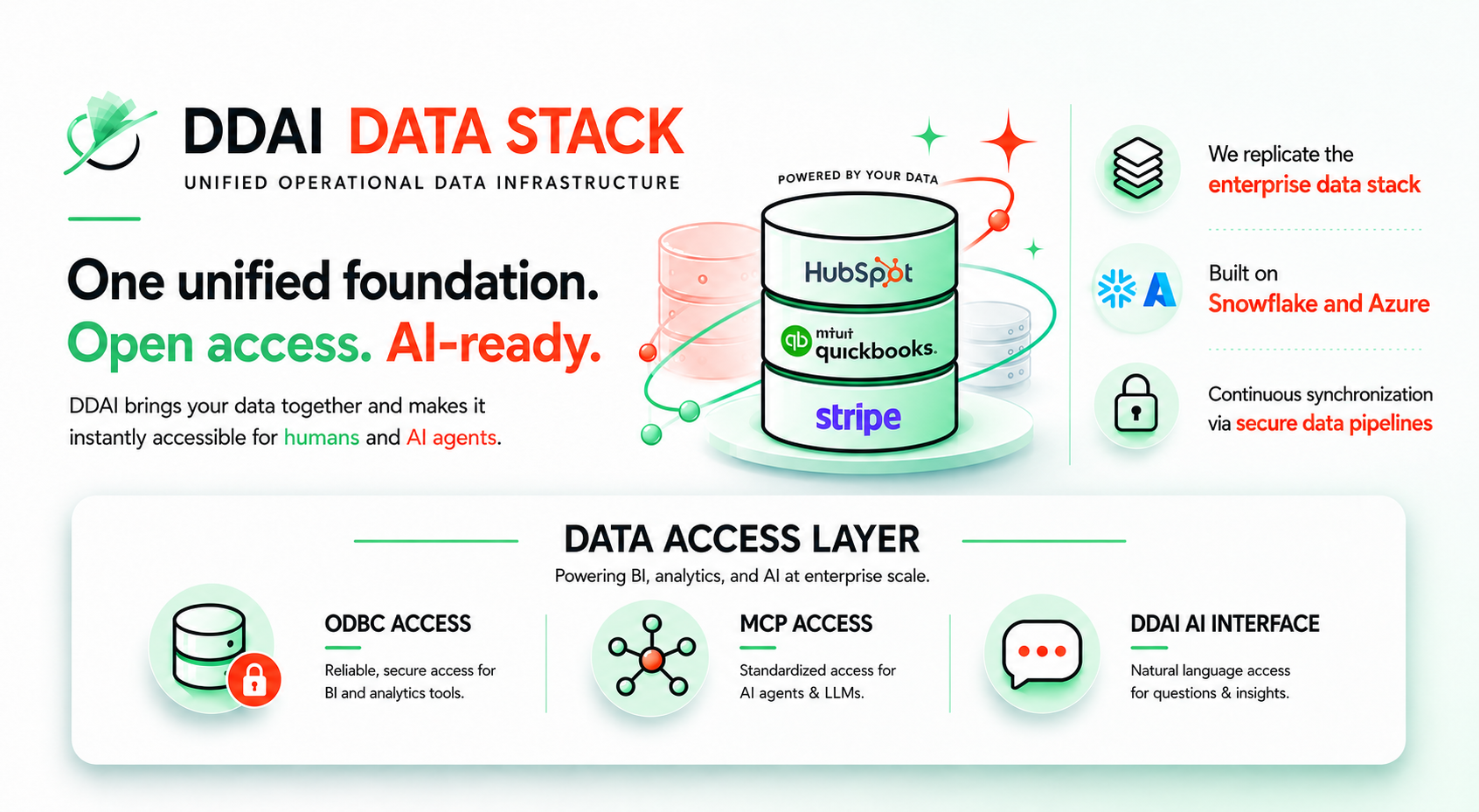
The companies getting the most value from AI aren't just connecting models directly to operational systems. They're building a modern data stack first.
In a modern data stack your cross system data is unified into a trusted operational layer—clean, governed, and continuously synced. Customer records are reconciled, revenue is standardized, and every team works from the same metrics and definitions.
Only then does MCP become truly powerful. Because now the AI isn't querying HubSpot or Stripe or QuickBooks. It's querying at all, a trusted representation of the business.
MCP Needs Clean Data.
There's a growing belief that MCP is the missing layer for enterprise AI. I think that's only partially true. MCP solves access. It doesn't solve consistency. It doesn't solve harmonization. It doesn't solve trust.
Those problems are solved by a clean operational data layer built on top of a modern data stack. Once that foundation exists, MCP becomes incredibly valuable because every AI application can access the same trusted version of the business.
Without that foundation, you've simply connected AI to another silo. And that's not transformation. That's just a better interface to the same old problem.